Author Archives: d.c. forrd

[ChevyChaseCommunity] DC Zoning Commission’s Vote on Chevy Chevy Commercial District January 30

This message seems to confound the availability of spaces for larger families with “affordability.”  For the first, building cods could be the problem.  I’ve heard that requiring double exits rather than just a outcome based fire safety standard makes it more difficult to design multi-bedroom units.   In any case, the solution cannot be to just impose a specific mix of unit design and price range. 
Thomas Hutcheson
(Writes “Radical Centrist”)

On Friday, February 7, 2025 at 10:52:24 AM EST, d.c. forrd <dc4reality@gmail.com&gt; wrote:


When Zoning Chairman Anthony Hood says “affordable housing is a problem” in Ward 3, the only real problem is that the housing he and the Commission, and the Office of Planning, and the Attorney General’s Office, and the Mayor, perhaps the Councilmember, or anyone else touting it — the housing they are talking about is NOT truly affordable for anyone who really needs it the most.  

That is, DC’s so-called affordable housing is out of reach of all working-class residents making DC’s minimum wage and certainly families because the income bar is purposely set so high as to shut them out

This isn’t rhetoric. The recent independent DC Auditor’s report shows these facts, which I found here — click this link.


Key findings from the Auditor Report on DC’s primary “affordable” housing production program:
  • More than half of DC’s primary “affordable” housing units (called IZ) have been built to serve the 80% AMI/MFI bracket of IZ-registered households (~1,050 / ~2,000 IZ units set at 80% MFI).

  • 65% of the IZ units were built for mostly single-persons, perhaps some two-person households (1,300 studio & 1-bedroom units had been built).

  • This means the vast majority of DC’s “affordable” units are for professionals making $85,000/year.

  • More than 4,600 IZ registrants are 3+ person households (families) vying for just one hundred and twenty-three (123) three+ bedroom IZ units built.


So, we should all have a problem with DC’s “affordable” housing IZ program — IT’S NOT AFFORDABLE — yet serves as the convenient guise to allow private developers to profit from building more unaffordable luxury housing, in this case on the public Commons at the expense of permanently disturbing the public assets we have there.

For those clamoring for more unaffordable IZ units, I can assure you they will be peppered throughout all the new density up and down Wisconsin, Connecticut, etc.


Even Chairman Hood understood how all this works at one point: https://www.youtube.com/watch?v=oTFXDTg8KPg

“I can tell you, some of the concerns that I’ve had, not just with this case, I hear all this about affordable housing and we talk about it all the time and don’t get me started. [I’m] really getting on this because from my standpoint, I’ve said this previously, [on] affordable housing, it seems like the more housing we get the more the price goes up.  I hear the argument Mr. Dettman, that if you increase the supply, [let me] make sure I got my economics right, if you increase the supply the cost comes down. [But] we increase the supply and [the price of housing] goes up. That’s Anthony Hood’s opinion. I’m a realist. I’m going about what I see, not what I hear, because if I go by what I hear, yea everything is affordable.”


Bottom-line: We don’t want more unaffordable housing built on public land. Building more unaffordable housing doesn’t reduce prices of housing, it’s harming us.

Certainly the other day folks at the DMPED oversight hearing comprehend and feel it and took time to speak up.

For example Rondell Jordan said (https://www.youtube.com/live/R44Nifxaw6E?feature=shared&t=14648):


(4:05:44) “The inclusionary zoning program, touted as a solution to housing affordability, has been nothing but a smokescreen for gentrification. IZ has done more to fuel displacement of Black residents than to stop it.”

(4:06:14) “The district’s flagship affordable housing program amounts to nothing more than modern-day redlining. Instead of red lines on a map, we now have affordability requirements rigged to exclude Black residents.”


It’s time for the “affordable housing” charade to end.

There are solutions — let’s start discussing a social housing model aka human housing aka grown-folks housing aka resilient and self-propelled housing on public land.

Chris Otten
DC for Reasonable Development


On Thursday, February 6, 2025, John Wheeler via groups.io <johnwheeler.dc=gmail.com@groups.io” target=”_blank” rel=”noreferrer noopener”>gmail.com@groups.io> wrote:

There was no misstatement in my post. ANCs are statutorily required to provide at least two forms of notice for meetings. While DC OAG has previously stated in prior guidance letters that posting notice via email listserv is acceptable, “posting a meeting notice on the ANC website could qualify as another ‘manner approved by the Commission’ as long as the ANC approved it by vote.” ANC 3/4G’s bylaws do not specify that valid notice includes posting on the ANC’s website. So, unless the ANC specifically voted at the 1/27 meeting to provide notice via its website of the 1/29 special meeting, then the special meeting would be invalid.

And it is nonsensical to argue that the meeting was urgent because the Zoning Commission was meeting the next day to decide the case that was the subject of the urgent meeting. Yet the ANC knew of the meetings months before and had discussed it months before. The urgency was created by the ANC failure to act sooner, not a lack of notice.

As to the substance of the ANC’s last second resolution:

1. The notion that there is anything that has not been said in testimony already given before the Zoning Commission or in the years of public discussion that might have been said in a contested hearing doesn’t make sense—they heard from the ANC and affected people, they just were not convinced that the ANC’s concerns outweighed the goals of the Comprehensive Plan and the affordable housing crisis.

2. Chairman Hood’s question concerning the negative reaction to affordable housing in Rock Creek West is perfectly legitimate. Many people are asking the same thing.
3. The response to my post shows a lack of knowledge of how a contested hearing is conducted. Parties (that includes the ANC) have a limited amount of time to present a case. A party cannot cross-examine the decision makers (members of the Zoning Commission). A party can cross examine witnesses. That also means that ANC commissioners, assuming they are witnesses, can be cross-examined. The ANC would be required to submit well in advance of the hearing, its list of witnesses, a statement of what each witness will say, and what it intends to prove. To do it right, is a lot of work. However, in this case, I cannot imagine there would be any testimony that has not already been given over and over at the Rulemaking hearing. So, in the end, it is a big waste of lots of people’s time with the Zoning Commission reaching the same decision. 
 
John Wheeler


To correct the misstatements of a prior post, first, that ANC 3/4G illegally conducted its January 29th meeting, DC Code § 1-309.11(c) allows for ANC meetings to be held on short notice “. . . in the case of an emergency or for other good cause articulated in the notice.” The situation was critically time-sensitive given that the Zoning Commission was to meet the next day to ratify its earlier decisions in case 23-25, addressing the rezoning of upper Connecticut Avenue from Livingston St. to Chevy Chase Circle. The ANC gave notice to the community and approximately 60 participants attended the meeting online, which is in keeping with usual online attendance.
 
With respect to the ANC’s resolution noting bias in the case by Anthony Hood, Chairman of the Zoning Commission, his remarks are available on YouTube, as cited below.
 
November 9, 2023 (https://www.youtube.com/watch?v=8A0ZQjAbjYs, starting at 2:06:50): “…every time there’s something done in uh West Rock Creek there’s always much much opposition and I want to submit that to the to the residents of Rock Creek West the whole other City we’re trying to make it affordable for people to live in what is it about affordable housing that Rock Creek West and I know this is probably gonna give me they’re gonna come after me but that’s fine I’m used to it now what is it about Rock Creek West it always there’s a problem with and not this not my first time saying it’s always a problem with affordable housing what is it really that’s trying to happen there I’m make no accusation I’m just curious uh I know there’s some maybe some zoning issues but it’s whenever it’s affordable housing I notice there’s a lot of opposition that gets drummed up and that’s not a question for office of planning that’s for the public so I will be asking that question as if we move if it’s set down.”

April 29, 2024 (https://www.youtube.com/watch?v=8MiDnfH9EqI, starting at 2:52:00): “So why is it that every time something comes up, the word of affordable housing comes up in Ward Three, it’s a major issue? Am I missing something here? Why is it that the rest of the city accepts it and does it, but when it comes to this area, it’s always something?”

May 23, 2024 (https://www.youtube.com/watch?v=T18uiysiL0g, starting at 2:59:00): A Chevy Chase resident asks Chair Hood to retract his remarks about Ward Three. At 3:12:30 Chair Hood responds to her request, saying that he stands by his comments about Ward Three. “Every time you talk about affordable housing, there seems to be a problem.”
 
The Zoning Commission’s decision to conduct rulemaking as opposed to a contested hearing process for case 23-25 effectively precluded the ANC from cross-examining Chair Hood to challenge his assertions. His bias against our community could have played a role in the Zoning Commission’s decision to make it a rulemaking case in the first place, limiting the ANC’s involvement. Furthermore, it could have played a role in the Zoning Commission’s failure to give proper notice to the ANC of the November 9, 2023, hearing referenced above when the Zoning Commission “set down” the case as rulemaking. That was the one and only opportunity for the ANC to argue for a contested case at the set down.

Consequently, far from addressing “in great detail” concerns raised by the ANC about case 23-25, the Zoning Commission followed a process that by design prevented the ANC from going into great detail. It not only restricted our ability to question Chair Hood on his comments, but also to represent in full the views of our constituents.

By November 2023, the ANC had just completed the largest survey in its history, probing the opinions of our residents regarding the proposed redevelopment of the Civic Core. These opinions were brushed aside by the Zoning Commission, which gave the ANC hardly more time to testify than DC residents who do not even reside in Chevy Chase.

Surely, the many important issues created by the upzoning of Upper Connecticut Avenue that will irreparably impact the community deserved a full and fair airing before an impartial Zoning Commission. Indeed, all DC residents deserve a fair, unbiased zoning process regardless of which ward they live in.
 
Liz Nagy
Commissioner (Secretary)
ANC 3/4G-07

_._,_._,_

Groups.io Links:

You receive all messages sent to this group.

View/Reply Online (#331462) | ChevyChaseCommunity@groups.io?subject=Re:%20Re%3A%20%5BChevyChaseCommunity%5D%20DC%20Zoning%20Commission%27s%20Vote%20on%20Chevy%20Chevy%20Commercial%20District%20January%2030″ target=”_blank” rel=”noreferrer noopener”>Reply to Group | Mute This Topic | New Topic


To post a message to this listserv, send an email to: ChevyChaseCommunity@groups.io” target=”_blank” rel=”noreferrer noopener”>ChevyChaseCommunity@groups.io . Put this email address into your contacts list. You do not need to go to the listserv’s website in order to post to this forum. The website *does* have a huge archive of messages which every list member should know how to search.

Listserv Rules: Sign your full name to messages. When posting emails to the listserv, do not ask for private replies unless selling or giving away items. When replying to an email, send your response to the list so all can benefit and the information can be later retrieved in an archive search. When disagreeing with members, or during contentious discussions only, avoid using `you` and `your` words. Focus on issues, not individuals, unless comments are about public or elected figures doing their jobs. Write short, descriptive subject lines. Use asterisks to *emphasize* a word, not ALL CAPS. Emails will be revised or returned that do not comply with these rules.

To join this group, send your name, home address and telephone numbers, in confidence, to the Listserv Moderators at: ChevyChaseCommunity+owner@Groups.io


Your Subscription | ChevyChaseCommunity+owner@groups.io” target=”_blank” rel=”noreferrer noopener”>Contact Group Owner | Unsubscribe [dc4reality@gmail.com” target=”_blank” rel=”noreferrer noopener”>dc4reality@gmail.com]

_._,_._,_


You received this message because you are subscribed to the Google Groups “Wardman Hotel Strategy Team” group.
To unsubscribe from this group and stop receiving emails from it, send an email to wardman-hotel-strategy-team+unsubscribe@googlegroups.com” target=”_blank” rel=”noreferrer noopener”>wardman-hotel-strategy-team+unsubscribe@googlegroups.com.
To view this discussion visit https://groups.google.com/d/msgid/wardman-hotel-strategy-team/CACG2_6siHX0QexeALv_ZcnZT3rtshDRrSPZJ4Rd7sN6QZaEzkA%40mail.gmail.com.
For more options, visit https://groups.google.com/d/optout.

[ChevyChaseCommunity] DC Zoning Commission’s Vote on Chevy Chevy Commercial District January 30


When Zoning Chairman Anthony Hood says “affordable housing is a problem” in Ward 3, the only real problem is that the housing he and the Commission, and the Office of Planning, and the Attorney General's Office, and the Mayor, perhaps the Councilmember, or anyone else touting it — the housing they are talking about is NOT truly affordable for anyone who really needs it the most.  

That is, DC's so-called affordable housing is out of reach of all working-class residents making DC's minimum wage and certainly families because the income bar is purposely set so high as to shut them out

This isn't rhetoric. The recent independent DC Auditor's report shows these facts, which I found here — click this link.


Key findings from the Auditor Report on DC's primary “affordable” housing production program:
  • More than half of DC's primary “affordable” housing units (called IZ) have been built to serve the 80% AMI/MFI bracket of IZ-registered households (~1,050 / ~2,000 IZ units set at 80% MFI).

  • 65% of the IZ units were built for mostly single-persons, perhaps some two-person households (1,300 studio & 1-bedroom units had been built).

  • This means the vast majority of DC's “affordable” units are for professionals making $85,000/year.

  • More than 4,600 IZ registrants are 3+ person households (families) vying for just one hundred and twenty-three (123) three+ bedroom IZ units built.


So, we should all have a problem with DC's “affordable” housing IZ program — IT'S NOT AFFORDABLE — yet serves as the convenient guise to allow private developers to profit from building more unaffordable luxury housing, in this case on the public Commons at the expense of permanently disturbing the public assets we have there.

For those clamoring for more unaffordable IZ units, I can assure you they will be peppered throughout all the new density up and down Wisconsin, Connecticut, etc.


Even Chairman Hood understood how all this works at one point: https://www.youtube.com/watch?v=oTFXDTg8KPg

“I can tell you, some of the concerns that I've had, not just with this case, I hear all this about affordable housing and we talk about it all the time and don't get me started. [I'm] really getting on this because from my standpoint, I've said this previously, [on] affordable housing, it seems like the more housing we get the more the price goes up.  I hear the argument Mr. Dettman, that if you increase the supply, [let me] make sure I got my economics right, if you increase the supply the cost comes down. [But] we increase the supply and [the price of housing] goes up. That's Anthony Hood's opinion. I'm a realist. I'm going about what I see, not what I hear, because if I go by what I hear, yea everything is affordable.”


Bottom-line: We don't want more unaffordable housing built on public land. Building more unaffordable housing doesn't reduce prices of housing, it's harming us.

Certainly the other day folks at the DMPED oversight hearing comprehend and feel it and took time to speak up.

For example Rondell Jordan said (https://www.youtube.com/live/R44Nifxaw6E?feature=shared&t=14648):


(4:05:44) “The inclusionary zoning program, touted as a solution to housing affordability, has been nothing but a smokescreen for gentrification. IZ has done more to fuel displacement of Black residents than to stop it.”

(4:06:14) “The district’s flagship affordable housing program amounts to nothing more than modern-day redlining. Instead of red lines on a map, we now have affordability requirements rigged to exclude Black residents.”


It's time for the “affordable housing” charade to end.

There are solutions — let's start discussing a social housing model aka human housing aka grown-folks housing aka resilient and self-propelled housing on public land.

Chris Otten
DC for Reasonable Development


On Thursday, February 6, 2025, John Wheeler via groups.io <johnwheeler.dc=gmail.com@groups.io> wrote:

There was no misstatement in my post. ANCs are statutorily required to provide at least two forms of notice for meetings. While DC OAG has previously stated in prior guidance letters that posting notice via email listserv is acceptable, “posting a meeting notice on the ANC website could qualify as another 'manner approved by the Commission' as long as the ANC approved it by vote.” ANC 3/4G's bylaws do not specify that valid notice includes posting on the ANC's website. So, unless the ANC specifically voted at the 1/27 meeting to provide notice via its website of the 1/29 special meeting, then the special meeting would be invalid.

And it is nonsensical to argue that the meeting was urgent because the Zoning Commission was meeting the next day to decide the case that was the subject of the urgent meeting. Yet the ANC knew of the meetings months before and had discussed it months before. The urgency was created by the ANC failure to act sooner, not a lack of notice.

As to the substance of the ANC’s last second resolution:

1. The notion that there is anything that has not been said in testimony already given before the Zoning Commission or in the years of public discussion that might have been said in a contested hearing doesn’t make sense—they heard from the ANC and affected people, they just were not convinced that the ANC’s concerns outweighed the goals of the Comprehensive Plan and the affordable housing crisis.

2. Chairman Hood’s question concerning the negative reaction to affordable housing in Rock Creek West is perfectly legitimate. Many people are asking the same thing.
3. The response to my post shows a lack of knowledge of how a contested hearing is conducted. Parties (that includes the ANC) have a limited amount of time to present a case. A party cannot cross-examine the decision makers (members of the Zoning Commission). A party can cross examine witnesses. That also means that ANC commissioners, assuming they are witnesses, can be cross-examined. The ANC would be required to submit well in advance of the hearing, its list of witnesses, a statement of what each witness will say, and what it intends to prove. To do it right, is a lot of work. However, in this case, I cannot imagine there would be any testimony that has not already been given over and over at the Rulemaking hearing. So, in the end, it is a big waste of lots of people’s time with the Zoning Commission reaching the same decision. 
 
John Wheeler


To correct the misstatements of a prior post, first, that ANC 3/4G illegally conducted its January 29th meeting, DC Code § 1-309.11(c) allows for ANC meetings to be held on short notice “. . . in the case of an emergency or for other good cause articulated in the notice.” The situation was critically time-sensitive given that the Zoning Commission was to meet the next day to ratify its earlier decisions in case 23-25, addressing the rezoning of upper Connecticut Avenue from Livingston St. to Chevy Chase Circle. The ANC gave notice to the community and approximately 60 participants attended the meeting online, which is in keeping with usual online attendance.
 
With respect to the ANC’s resolution noting bias in the case by Anthony Hood, Chairman of the Zoning Commission, his remarks are available on YouTube, as cited below.
 
November 9, 2023 (https://www.youtube.com/watch?v=8A0ZQjAbjYs, starting at 2:06:50): “…every time there's something done in uh West Rock Creek there's always much much opposition and I want to submit that to the to the residents of Rock Creek West the whole other City we're trying to make it affordable for people to live in what is it about affordable housing that Rock Creek West and I know this is probably gonna give me they're gonna come after me but that's fine I'm used to it now what is it about Rock Creek West it always there's a problem with and not this not my first time saying it's always a problem with affordable housing what is it really that's trying to happen there I'm make no accusation I'm just curious uh I know there's some maybe some zoning issues but it's whenever it's affordable housing I notice there's a lot of opposition that gets drummed up and that's not a question for office of planning that's for the public so I will be asking that question as if we move if it's set down.”

April 29, 2024 (https://www.youtube.com/watch?v=8MiDnfH9EqI, starting at 2:52:00): “So why is it that every time something comes up, the word of affordable housing comes up in Ward Three, it’s a major issue? Am I missing something here? Why is it that the rest of the city accepts it and does it, but when it comes to this area, it’s always something?”

May 23, 2024 (https://www.youtube.com/watch?v=T18uiysiL0g, starting at 2:59:00): A Chevy Chase resident asks Chair Hood to retract his remarks about Ward Three. At 3:12:30 Chair Hood responds to her request, saying that he stands by his comments about Ward Three. “Every time you talk about affordable housing, there seems to be a problem.”
 
The Zoning Commission’s decision to conduct rulemaking as opposed to a contested hearing process for case 23-25 effectively precluded the ANC from cross-examining Chair Hood to challenge his assertions. His bias against our community could have played a role in the Zoning Commission’s decision to make it a rulemaking case in the first place, limiting the ANC’s involvement. Furthermore, it could have played a role in the Zoning Commission’s failure to give proper notice to the ANC of the November 9, 2023, hearing referenced above when the Zoning Commission “set down” the case as rulemaking. That was the one and only opportunity for the ANC to argue for a contested case at the set down.

Consequently, far from addressing “in great detail” concerns raised by the ANC about case 23-25, the Zoning Commission followed a process that by design prevented the ANC from going into great detail. It not only restricted our ability to question Chair Hood on his comments, but also to represent in full the views of our constituents.

By November 2023, the ANC had just completed the largest survey in its history, probing the opinions of our residents regarding the proposed redevelopment of the Civic Core. These opinions were brushed aside by the Zoning Commission, which gave the ANC hardly more time to testify than DC residents who do not even reside in Chevy Chase.

Surely, the many important issues created by the upzoning of Upper Connecticut Avenue that will irreparably impact the community deserved a full and fair airing before an impartial Zoning Commission. Indeed, all DC residents deserve a fair, unbiased zoning process regardless of which ward they live in.
 
Liz Nagy
Commissioner (Secretary)
ANC 3/4G-07

_._,_._,_

Groups.io Links:

You receive all messages sent to this group.

View/Reply Online (#331462) |
Reply to Group
|
Mute This Topic
| New Topic


To post a message to this listserv, send an email to: ChevyChaseCommunity@groups.io . Put this email address into your contacts list. You do not need to go to the listserv's website in order to post to this forum. The website *does* have a huge archive of messages which every list member should know how to search.

Listserv Rules: Sign your full name to messages. When posting emails to the listserv, do not ask for private replies unless selling or giving away items. When replying to an email, send your response to the list so all can benefit and the information can be later retrieved in an archive search. When disagreeing with members, or during contentious discussions only, avoid using `you` and `your` words. Focus on issues, not individuals, unless comments are about public or elected figures doing their jobs. Write short, descriptive subject lines. Use asterisks to *emphasize* a word, not ALL CAPS. Emails will be revised or returned that do not comply with these rules.

To join this group, send your name, home address and telephone numbers, in confidence, to the Listserv Moderators at: ChevyChaseCommunity+owner@Groups.io


Your Subscription | Contact Group Owner |
Unsubscribe
[dc4reality@gmail.com]

_._,_._,_

Fwd: [1617 U Street List] When Will We Stop Selling Off Our Future? Re: [adamsmorgan] $146M Loan For Donatelli’s Columbia Heights Apartment Complex Hits Special Servicing

———- Forwarded message ———-
From: Chris R. Otten <crotten2@gmail.com>

Subject: [1617 U Street List] When Will We Stop Selling Off Our Future? Re: [adamsmorgan] $146M Loan For Donatelli's Columbia Heights Apartment Complex Hits Special Servicing
To: adamsmorgan@groups.io
Cc: “Nadeau, Brianne K. (Council)” <bnadeau@dccouncil.gov>, chenderson@dccouncil.gov, kmcduffie@dccouncil.gov, rwhite@dccouncil.gov, abonds@dccouncil.gov, bpinto@dccouncil.us, pmendelson@dccouncil.gov, jlewisgeorge@dccouncil.gov

When Will We Stop Selling Off Our Future?

How many times must we watch public land and air rights handed over by the Mayor and Council, only to be exploited by real estate speculators in pursuit of immense profits? These public land deals—complete with tax abatements and blessed zoning entitlements—quickly enrich fly-by-night land-hucksters peddling the illusion of Inclusionary Zoning (IZ) units and more “market-rate” housing. Meanwhile, they prop up the mercantile class (bankers) at the expense of our public assets, increase displacement pressures, and make a mockery of the basic human right to safe, dignified shelter.

The private real estate market, built on collusion and profiteering, cannot solve the affordable housing crisis it continues to fuel. 

Decision-makers with a duty of care to the public must recognize that we cannot build our way out of this crisis with more luxury housing and the woefully inadequate, some say failed “affordable” IZ program.

We need bold policy shifts to decommodify housing, stabilize costs, and ultimately bring them down.

Social housing—a proven model in cities worldwide—offers a real path forward. It’s time to end this cycle of public giveaways and start systemically investing in structurally sound and effective housing policies that prioritize DC's people over some private-developer's profit margins.

The story below is yet another painful reminder of why DC's posture must change. Let’s end the giveaways once and for all.

Chris Otten, SHIMBY


On Thu, Jan 16, 2025 at 4:28 PM William Jordan via groups.io <whj=melanet.com@groups.io> wrote:


DC's entire housing policy foundations, especially affordable, are built upon the assumption that this project was a run-a-way success.   This project receive basically free city land, a tax abatement bailout, allowed to renege on community benefits requirements including affordability, and a zoning free hand.   


I was just at a National League of Cities event where everyone was applauding this as the future of housing and public private partnerships.


Let the bailout begin.


William


$146M Loan For Donatelli's Columbia Heights Apartment Complex Hits Special Servicing

The developer of a 373-unit apartment building next to the Columbia Heights Metro station has yet to pay back its loan after it matured in July.

Placeholder
The Highland Park apartment complex next to the Columbia Heights Metro station.

At least two securitized pieces of Donatelli Development’s $146M loan on the Highland Park building at 1400 Irving St. NW were transferred to special servicing in October, according to December servicer commentary in the Morningstar Credit database. 

Donatelli didn't respond to a request for comment. The special servicer, CBRE Loan Services, declined to comment.

The property was refinanced for $146M in July 2022, and two pieces of that loan totaling $74M and $30M were sold into commercial real estate collateralized loan obligation pools.

The property was 85% occupied when the loan was issued, and it has since increased to 95%, but it appears the landlord hasn't hit targets for rent increases. The issuer projected the net operating income would reach roughly $9M at stabilization, but the property's latest reported NOI was $7.2M, according to Morningstar. 

“It looks like it’s not hitting its plan, and trying to refi in this environment but with this amount of debt was always going to be a challenge,” Morningstar Credit Head of CRE Analytics David Putro told Bisnow.

The 18K SF of ground-floor retail is occupied by Z-Burger, a mediterranean restaurant, a coffee shop and a Lou’s City Bar. The Wawa at the property closed in June 2022, but the company has a corporate guarantee to pay the rent through 2034, according to a Morningstar presale report on one of the loan pieces. 

The presale report said Donatelli planned to “increase the multifamily rents, stabilize the residential occupancy, and back-fill the dark Wawa commercial space.”

Highland Park was appraised at $204M when the loan was originated. The property doesn't appear to have any more recent appraisals.

Donatelli completed the project's two phases in 2009 and 2013. The development cost was $70M, according to D.C.'s Office of the Deputy Mayor for Planning and Economic Development, which said 20% of the apartments were reserved as affordable.

The neighborhood surrounding Highland Park has had a few notable closings over the past year. The CVS across 14th Street closed last February, citing crime as the reason. Across Irving Street from the property, the 540K SF DC USA mall saw Petco close last week, while DSW is also set to shutter this month, Popville reported. They follow Five Below’s closure at the mall last January. Just over 81K SF at DC USA is being marketed on LoopNet.

Contact Emily Wishingrad at emily.wishingrad@bisnow.com

_._,_._,_

Groups.io Links:

You receive all messages sent to this group.

View/Reply Online (#66678) |
Reply to Group | Reply to Sender
|
Mute This Topic
| New Topic


Welcome to the Adams Morgan listserv, founded by JB Fields and Josh Gibson on October 26, 1999. RIP, J.
Onelist begat EGroups begat Yahoo Groups begat Groups.io
List Administrators: Josh Gibson and George Schmitt.
In Adams Morgan we trust.


Your Subscription | Contact Group Owner |
Unsubscribe
[crotten2@gmail.com]

_._,_._,_


You received this message because you are subscribed to the Google Groups “1617 U street project” group.
To unsubscribe from this group and stop receiving emails from it, send an email to 1617-u-street-project+unsubscribe@googlegroups.com.
To view this discussion visit https://groups.google.com/d/msgid/1617-u-street-project/CANhRiJi0464ODRWK0w%2Bgq5zXqBfper4GxAgEiY%2BMMRprhirMHA%40mail.gmail.com.

DC for Reasonable Development
(202) 854-8327‬
www.dc4reason.org

Independent DC Auditor Report on Inclusionary Zoning: Key Highlights & Citations [w/ PDF]

newlogo1617_425px.png
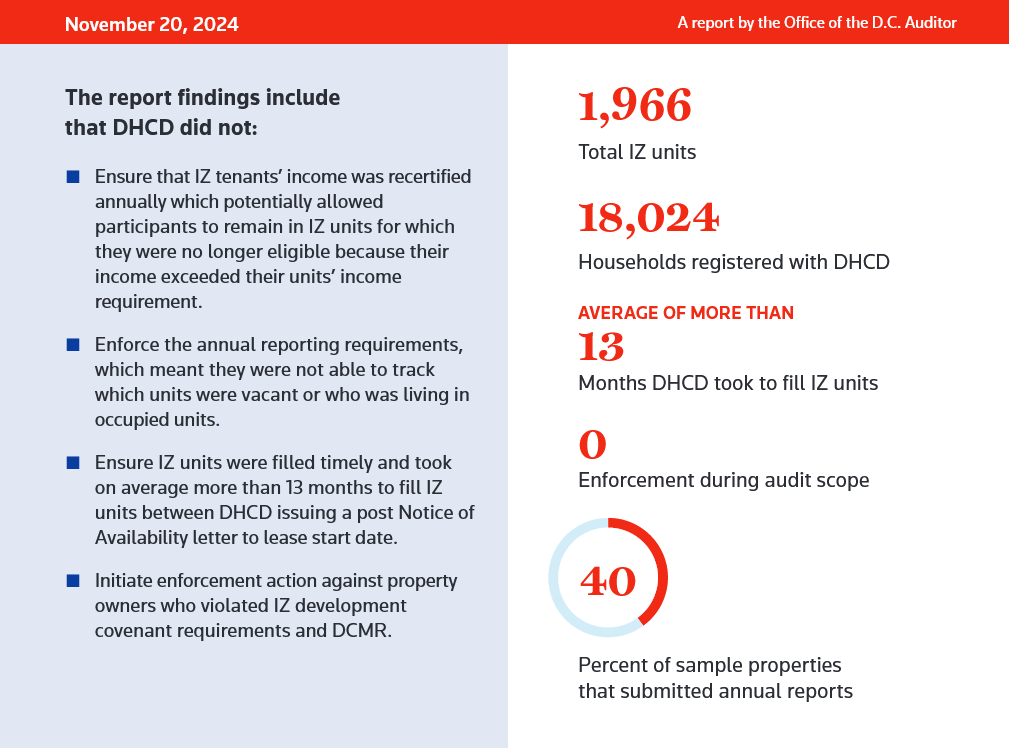
Reviewing the DC Auditor’s Independent Report on DC’s Inclusionary Zoning Program – The IZ program allows developers to receive zoning entitlements and to build bigger, taller luxury buildings in return for designating 8%-20% of the units as “affordable” since 2009

This document shows key highlights from the DC Auditor Report on the 15-year IZ program showing the results of the Mayor’s primarily touted “affordability” program

Screenshot 2025-01-11 192725.png
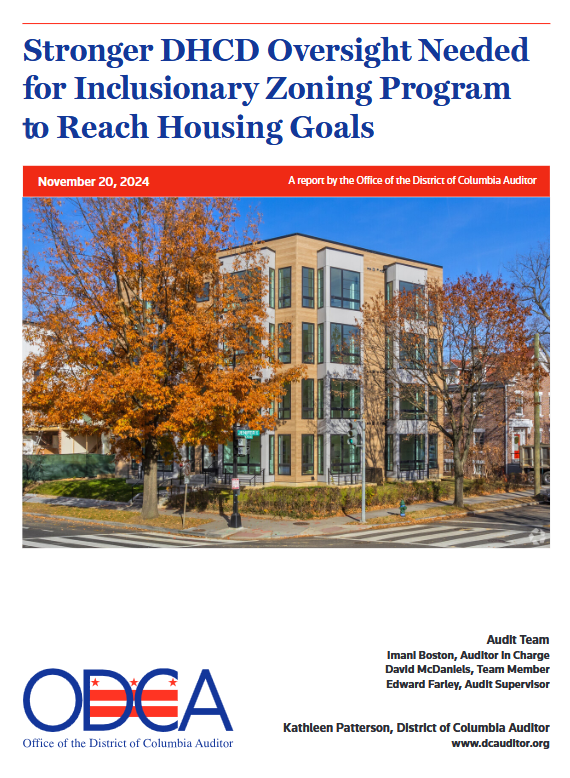
Report, “Stronger DHCD Oversight Needed for Inclusionary Zoning Program to Reach Housing Goals” published by Kathleen Patterson, District of Columbia Auditor, on November 20, 2024, https://dcauditor.wpenginepowered.com/wp-content/uploads/2024/11/Inclusionary.Zoning.Audit_.11.20.24.pdf


Auditor Report on IZ (“ARIZ”) highlights:

ARIZ, Cover page:
“The Inclusionary Zoning program is a key initiative identified by the Mayor as a pathway toward the afforda ble housing goal of producing 36,000 new housing units and 12,000 new affordable units by 2025.”
Screenshot 2025-01-12 141710.png

ARIZ, Background, at page 2:
The Inclusionary Zoning (IZ) program in Washington, D.C., was enacted in 2006 and initiated through the DC Comprehensive Plan, which includes policies and actions that set priorities for the District’s land use, public services, infrastructure, and capital investments. A 2008 Mayor’s Order designated DHCD as the authority responsible for administering the IZ program. [The IZ program] became effective in 2009 and the first units came to the housing market in 2011. The regulations state that the IZ program was created to further the Housing Element of the Comprehensive Plan through increasing the amount and expanding the geographic distribution of adequate affordable housing available to current and future residents. … The purpose of the program is to reduce the upward impact that market-rate development can have through increased affordable unit production with the goal of ultimately creating a full range of long-term housing choices for each District household regardless of size and income.

ARIZ at top of Page 3:
As of September 30, 2022, about 2,000 IZ units had been built. And, about 18,000 households were registered and waiting for an IZ unit.

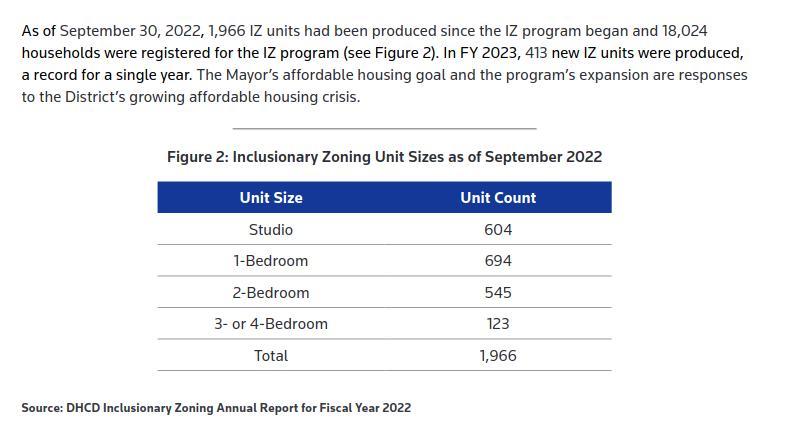
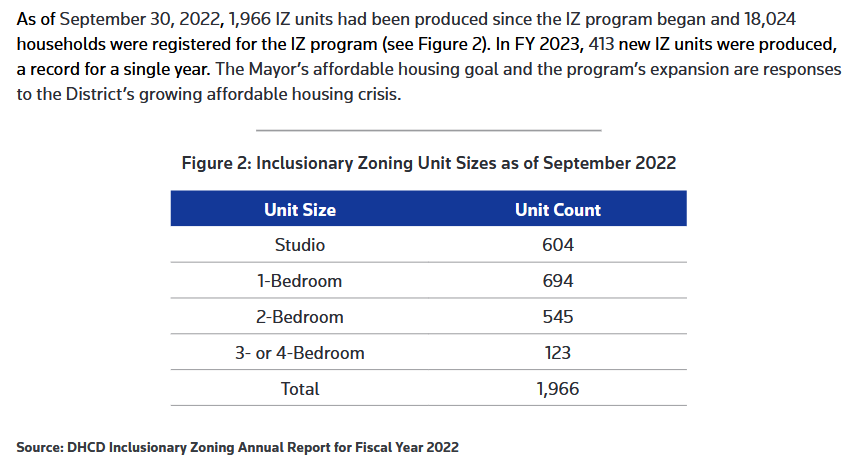
ARIZ, Figure 2, at Page 3:
Shows that as of Sep. 2022, 65% of the IZ units were built for single-person and some two-person households (1,300 studio & 1-bedroom units had been built).

Screenshot 2025-01-12 144146.png
Looking at Figure 2 at Page 3 of ARIZ and looking at the Mayor's FY2022 IZ Annual Report also at Figure 2:
It appears that more than 4,600 IZ registrants are 3+ person households (families) vying for just one hundred and twenty-three (123) three+ bedroom IZ units built.

ARIZ, Page 5, 4th bullet-point:
Some of the current IZ participating households may be spending 50% of their income on housing costs (this is unlawfully not affordable).

Screenshot 2025-01-12 144621.png
ARIZ at page 10:
IZ units sit vacant for an average of about 400 days, some units have sat vacant for 1000 days.

ARIZ at pages 14 – 16:
Since DHCD is not enforcing IZ annual reporting it's hard to track how many IZ units have been vacant or remain vacant since they were built. “Without annual reports, DHCD is unaware of the number of vacant (IZ) units” (at page 16).

ARIZ, pp 17-18:
DHCD did not initiate enforcement action against property owners who violated IZ development covenant requirements. “Despite properties’ non compliance with income recertification, lease renewal, and annual report requirements, DHCD did not initiate enforcement actions against any property owners” (p18).


ARIZ at page 5:
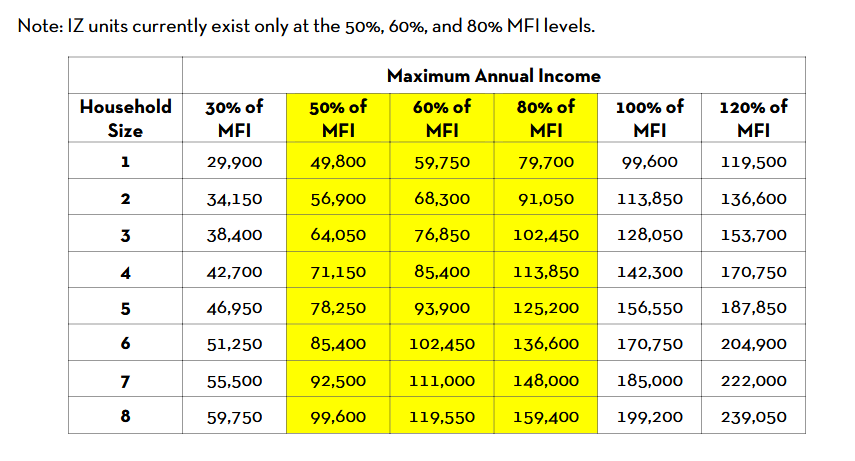
IZ units serve households making “no more than 50%, 60%, or 80% of the MFI.” MFI stands for Median Family Income and is interchangable with AMI or the Area Median Income. And, according to the Mayor's Inclusionary Zoning Program 2022-2023 Maximum Income, Rent and Purchase Price Schedule, Effective July 1, 2022, figure at page 2, Single-household IZ registrants making $79,700 annually could qualify and live in an “affordable” IZ unit, and, a family of four making $113,850/yr could qualify for a 3-bedroom IZ unit.

Screenshot 2025-01-11 194408.png
ARIZ at page 5, footnote #8:
The AMI/MFI is increasing annually: “On April 1, 2021, the MFI in Washington, D.C., was $129,000 for a household of four. On April 18, 2022, the MFI rose to $142,300.” And, according to the Mayor's FY2022 IZ Annual Report, at Figure 4, more than half of IZ units have been built to serve the 80% AMI/MFI bracket of IZ-registered households (~1,050 / ~2,000 IZ units set at 80% MFI).
Other notes and data:

####


DC Auditor Independent Report on IZ: Key Highlights & Citations

Screenshot 2025-01-11 192725.png
Review of key highlights from the DC Auditor Report on the 15-year IZ program showing the failure of this touted “affordability” program for the people of DC while serving as a luxury density boon for DC's real estate speculator class.

Report, “Stronger DHCD Oversight Needed for Inclusionary Zoning Program to Reach Housing Goals” published by Kathleen Patterson, District of Columbia Auditor, on November 20, 2024, https://dcauditor.wpenginepowered.com/wp-content/uploads/2024/11/Inclusionary.Zoning.Audit_.11.20.24.pdf


Auditor Report on IZ (“ARIZ”) highlights:

ARIZ at top of Page 3:
As of September 30, 2022, about 2,000 IZ units had been built. And, about 18,000 households were registered and waiting for an IZ unit.

ARIZ, Figure 2, at Page 3:
Shows that as of Sep. 2022, 65% of the IZ units were built for single-person and some two-person households (1,300 studio & 1-bedroom units had been built).

Looking at Figure 2 at Page 3 of ARIZ and looking at the Mayor's FY2022 IZ Annual Report also at Figure 2:

It appears that more than 4,600 IZ registrants are 3+ person households (families) vying for just one hundred and twenty-three (123) three+ bedroom IZ units built.

ARIZ, Page 5, 4th bullet-point:
Some of the current IZ participating households may be spending 50% of their income on housing costs (this is unlawfully not affordable).

ARIZ at page 10:
IZ units sit vacant for an average of about 400 days, some units have sat vacant for 1000 days.

ARIZ at pages 14 – 16:
Since DHCD is not enforcing IZ annual reporting it's hard to track how many IZ units have been vacant or remain vacant since they were built. “Without annual reports, DHCD is unaware of the number of vacant (IZ) units” (at page 16).

ARIZ, pp 17-18:
DHCD did not initiate enforcement action against property owners who violated IZ development covenant requirements. “Despite properties’ non compliance with income recertification, lease renewal, and annual report requirements, DHCD did not initiate enforcement actions against any property owners” (p18).


ARIZ at page 5:
IZ units serve households making “no more than 50%, 60%, or 80% of the MFI.” MFI stands for Median Family Income and is interchangable with AMI or the Area Median Income. And, according to the Mayor's Inclusionary Zoning Program 2022-2023 Maximum Income, Rent and Purchase Price Schedule, Effective July 1, 2022, figure at page 2, Single-household IZ registrants making $79,000 annually could qualify and live in an “affordable” IZ unit, and, a family of four making $113,850/yr could qualify for a 3-bedroom IZ unit.

ARIZ at page 5, footnote #8:
The AMI/MFI is increasing annually: “On April 1, 2021, the MFI in Washington, D.C., was $129,000 for a household of four. On April 18, 2022, the MFI rose to $142,300.” And, according to the Mayor's FY2022 IZ Annual Report, at Figure 4, more than half of IZ units have been built to serve the 80% AMI/MFI bracket of IZ-registered households (~1,050 / ~2,000 IZ units set at 80% MFI).
Side note: It's been reported that in Washington, DC, a family of four needs to make $275,000/yr to live “comfortably”. https://www.cnbc.com/2024/03/27/how-much-money-family-of-4-needs-to-live-comfortably-in-us-cities.html

####


2025 New Years Resolution: Replace Failed “IZ” with Green New Deal for Housing

It's Time to Replace the Failed Inclusionary Zoning (IZ) “Affordable” Housing Program with the Green New Deal for Housing in 2025

For more info: www.dc4reality.org/updates

The recent independent DC Auditor report exposes the systemic flaws in the 15-year-old Inclusionary Zoning (IZ) program, highlighting a critical mismatch between the supply of IZ units and the demand for affordable housing. Despite its long policy duration, the program has failed to deliver on its promises:

  • Demand Outpaces Supply: With 18,000 households on the waitlist for only 2,000 IZ units, the program leaves tens of thousands without viable housing options.
  • Misalignment with Needs: 65% of IZ units are designed for singles, while most families on the waitlist need 3+ bedrooms. This imbalance exacerbates the housing crisis for family-sized households.
  • Unlawful “Affordability”: Many current IZ participants spend up to 50% of their income on housing costs, which directly contradicts the legally required principles of affordability (spending no more than 30% of one's income on housing costs).
  • Vacancy Loopholes: Developers gain lots of luxury density while leaving IZ units vacant, undermining the public good and sidelining the people the program is meant to serve.
  • Delayed Access: With an average move-in time of 13 months, IZ offers no timely relief for families in need.

After 15 years of broken promises, it's clear: Inclusionary Zoning is not the solution.

The Path Forward: Green New Deal for Social Housing in 2025

It’s time to replace the failed IZ model with social housing, a proven alternative that prioritizes people over profits:

  • True Affordability: Social housing ensures no household pays more than 30% of their income on rent.
  • Family-Focused Solutions: Units are designed to meet the actual needs of the community, especially families requiring larger spaces.
  • No Vacant Units: Publicly managed social housing eliminates developer loopholes, guaranteeing occupancy and stability.
  • Community Accountability: Social housing is run by public entities or non-profits, ensuring transparency and prioritizing the public good.
  • Fast and Equitable Access: By cutting through bureaucratic delays, social housing offers timely solutions for those in need.

2025: A Year for Truly Affordable Housing for All

As we enter 2025, we have an opportunity to embrace social housing as a transformative solution to the District’s housing crisis. It’s time to shift from failed policies to a bold new approach that guarantees housing as a human right.

Let’s move forward with social housing—because everyone deserves a place to call home.

###

See how disingenuous IZ really is and why :: click here :: https://www.youtube.com/watch?v=Y3_Hf_84Mn0


Chris O.
DC for Reasonable Development
www.dc4reason.org


DC for Reasonable Development
(202) 854-8327‬
www.dc4reason.org
#IZFAIL

New Years Resolution 2025: Replace IZ with Social Housing

The data and facts shared by the recent DC Auditor report on the failed 15-year Inclusionary Zoning program reveal the critical mismatch between the supply and demand for Inclusionary Zoning (IZ) units and systemic flaws in the program’s implementation, flaws that demonstrate that IZ should be replaced with Social Housing.

Here are the key points distilled from the the Auditor’s report and some broader implications:

Key Issues:

  1. Waitlist Disparity:
    • 18,000 households are on the IZ waitlist for only 2,000 units. This immense gap underscores the severe shortage of affordable housing options within the program.
    • Most waitlisted families require 3+ bedroom units, yet 65% of available IZ units are designed for single individuals, illustrating a misalignment between what’s being built and actual housing needs.
  2. Affordability Concerns:
    • Households participating in IZ are spending up to 50% of their income on housing, which is well above the affordability threshold and violates the program’s intent, showing the IZ program is not delivering truly affordable options for the targeted population.
  3. Vacancy Loopholes:
    • Developers gain the benefit of increased luxury density but are reportedly leaving IZ units vacant. This loophole undermines the purpose of the program and enables profit-driven motives to overshadow public interest.
  4. Lengthy Move-In Times:
    • The average 13-month waiting period to move into an IZ unit adds further strain on families and individuals already struggling to find stable housing.

Implications:

  • The Auditor’s Report demonstrates that the IZ program’s design and enforcement mechanisms are failing to address the actual housing crisis, favoring developer interests (providing lots more luxury density) over community needs (far too little “affordable” housing that isn’t truly affordable or targeted for families).

SO WHAT TO DO?!?

Focusing on social housing as the alternative to Inclusionary Zoning (IZ) will help address the structural issues highlighted by the Auditor’s startling IZ report. Social Housing, unlike IZ, prioritizes truly affordable, community-driven housing units that serves DC in the most efficient and reliable way.

Why Social Housing is the Solution

  1. Meeting Actual Demand:
    • Unlike IZ units, which are misaligned with household needs (e.g., 65% for singles while most families require 3+ bedrooms), social housing can be designed to cater directly to the demographics of the community, particularly families.
  2. Affordability Without Profit Motives:
    • Social housing operates outside the speculative market. Rents or costs are capped based on household income, ensuring no family pays more than 30% of their income on housing.
  3. No Vacant Units:
    • Social housing prioritizes occupancy. Units are not held vacant for profit-driven reasons but are allocated to households in need, ensuring that public resources are fully utilized.
  4. Community Stability:
    • Social housing fosters long-term stability by providing permanent, affordable housing rather than temporary or precarious arrangements like IZ units.
  5. Faster Access:
    • A well-managed social housing program avoids the excessive bureaucracy and delays of IZ, offering faster solutions to families on waitlists.
  6. Public Accountability:
    • Social housing is owned and managed by public entities or non-profits accountable to the community, rather than private developers prioritizing luxury profits.

Proposed Actions

  1. Advocate for Social Housing Pilot Projects:
    • Identify underutilized public land or existing properties that can be converted into social housing. Use these pilot projects (such as at 1617 U Street) to demonstrate the feasibility and effectiveness of social housing.
  2. Reallocate IZ Resources:
    • Redirect funds and incentives currently given to developers under IZ toward building and maintaining social housing units.
  3. Ensure Funding:
    • Leverage public financing (bonds, taxes on luxury developments, or inclusion of social housing in federal and state housing grants) to sustainably fund social housing projects.
  4. Prioritize Community Input:
    • Establish community boards to oversee social housing initiatives, ensuring developments meet local needs and maintain public trust.

Message for Advocacy

“Our current housing policies, like Inclusionary Zoning, are failing our communities. With 18,000 families on the waitlist for only 2,000 units—most of which are not even family-sized—it’s clear that the IZ program is not a solution. Social housing offers an alternative: truly affordable, stable, and community-oriented homes.

By moving away from developer-driven models and embracing public, accountable housing solutions, we can address the housing crisis and create a future where everyone has a place to call home. Let’s stop prioritizing luxury density and start prioritizing people. It’s time to invest in social housing.”

A PILOT AT 1617U STREET — See the latest filing here: https://app.dcoz.dc.gov/CaseReport/ViewExhibit.aspx?exhibitId=360852


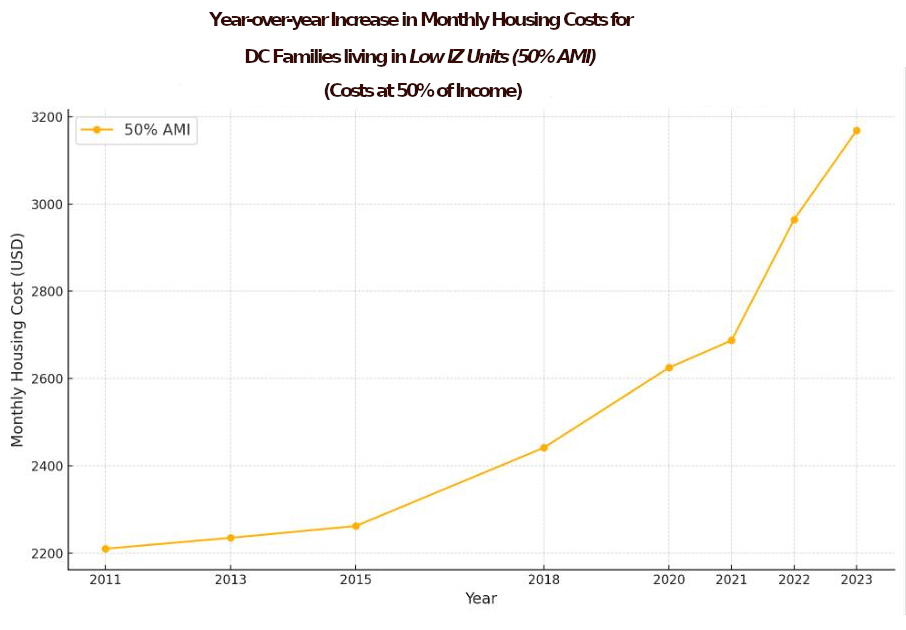
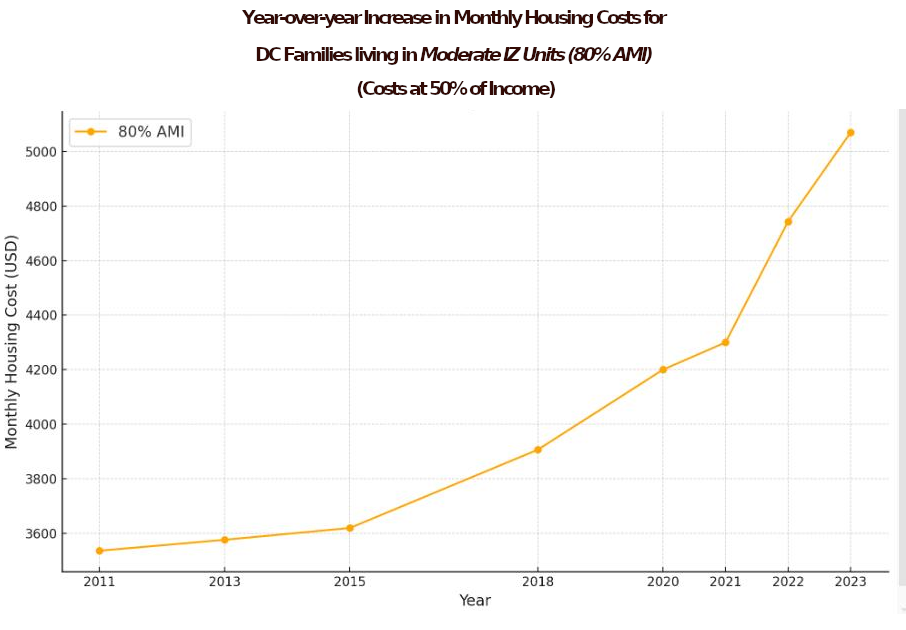
HOW BAD IS IZ?!?

See the charts below to see IZ housing costs based on the DMV’s Area Median Income using the Auditor’s discovery that some IZ participants are paying 50% of their income to real estate developers for their “affordable” IZ unit.


District Links: Council gives initial OK to Capital One Arena deal; education officials report 1.1% enrollment rise in DC’s public schools; and more

View this email in your browser
Tweet Tweet
Share Share
Forward Forward
The comprehensive DC politics roundup — Nov. 26, 2024

By Chris Kain
Reply with tips, links, events, things or send them to news@thedcline.org
DC Council gives initial OK to Capital One Arena deal
The DC Council today advanced legislation to authorize the District's $87.5 million purchase of Capital One Arena and finalize a redevelopment agreement with Monumental Sports & Entertainment little more than five weeks after the legislation's formal submission by Mayor Muriel Bowser.

Councilmembers briefly discussed the bill during a Committee of the Whole meeting prior to a unanimous vote in support of the measure. They later approved the bill as part of the consent agenda at the start of today's legislative meeting, with the required second vote expected at one of the council's December meetings in order to finalize approval before the end of the year.

Council Chair Phil Mendelson and other legislators didn't highlight any changes from the introduced version aside from an increase in the required threshold for contracting with certified business enterprises — now 40%, up from 35% in the agreement originally negotiated by the Bowser administration and Monumental. At-large Councilmember Kenyan McDuffie, chair of the Committee on Business and Economic Development, had pressed the issue, seeking a stronger provision notwithstanding Monumental's stated goal of 50% participation.

In their comments, Ward 2 Councilmember Brooke Pinto and Ward 6 Councilmember Charles Allen spoke enthusiastically about the agreement underlying the bill, which ensures the Washington Capitals and Wizards will remain at Gallery Place through at least 2050. The bill also authorizes use of $87.5 million in capital funds to purchase the arena — part of the $515 million of spending authorized in the fiscal year 2025 budget and financial plan, approved earlier this year. Monumental has committed to invest at least $285 million toward the renovations, including covering any cost overruns.

“I think this is a project that we should all be proud of,” Pinto said, citing the importance of ensuring that the arena is a “true anchor” of a vibrant downtown.

“I am very glad we are here today. We should have been here sooner,” Allen said, noting that it was about a year ago that team owner Ted Leonsis announced plans to move the teams to a state-of-the-art arena in Alexandria's Potomac Yard. After that deal fell apart, the District was able to negotiate a deal for the teams to stay in large part by committing capital funding toward the facility's renovation and expansion.

Allen reiterated his past criticism of DC officials for not doing more to keep the team prior to the emergence of the Virginia deal, noting that the Gallery Place arena creates year-round activity and therefore merits city investment. He and McDuffie both stressed the importance of finding ways to assist nearby businesses during three years of summertime construction at the arena, when its usual slate of events won't be taking place.

Under the timetable announced in October, which envisioned approval by the DC Council by the end of 2024, Monumental will begin design work this winter and construction in early summer 2025. Mendelson had vowed swift consideration of the bill but has stressed that it has proceeded not as emergency legislation but under regular procedures, including a public hearing held in mid-November.

This afternoon, Leonsis expressed his appreciation for the council's vote on social media.

“We are grateful to the D.C. Council for their support of our plan to deliver a best-in-class destination for fans, athletes, employees, and our community at a brand-new Capital One Arena,” he tweeted. “We look forward to the final Council vote and thank @ChmnMendelson and  @MayorBowser for their leadership. We share in their vision and commitment to a revitalized downtown and sustained, long-term prosperity which reaches across each of The District’s eight wards.”

— Background: 'Capital One Arena plans to be voted on by DC Council' ' [WTOP]; 'DC residents, businesses sound off on proposed Capital One Arena deal' [WTOP]

Today
DC officials today announced a third consecutive year of increased enrollment in public schools across the District — with 99,770 students in the 2024-25 school year according to preliminary data, a 1.1% increase from the prior year. The preliminary numbers for the current school year show 52,036 students at DCPS and 47,564 students in public charter schools. These are the highest annual enrollment totals for DC Public Schools and public charter schools since the Office of the State Superintendent of Education began compiling enrollment data in 2007. Over the past decade, overall enrollment has increased by 14.2%, according to OSSE. Officials say they hope to continue the momentum. “Our city has made historic investments in education, because when we invest in our students, we invest in the future of the District,” Mayor Muriel Bowser said. In announcing the enrollment numbers, OSSE highlighted the two EdFEST events planned for Dec. 7 and Dec. 14, where families can meet representatives from schools participating in the My School DC lottery. Admission is free, but registration is required.

  • DC Public Library locations will close early on Wednesday in advance of the Thanksgiving holiday. Neighborhood libraries will be open from 9 a.m. to 4:30 p.m., co-located libraries will be open from 10 a.m. to 4:30 p.m., and the Martin Luther King Jr. Memorial Library will be open from 9:30 a.m. to 4:30 p.m. All branches will be closed on Thursday.
 'D.C.’s smut king and a MAGA conspiracy theorist could soon join the Foggy Bottom-West End ANC.' City Paper's Alex Koma: “After a few years of chaos, everything seemed to be getting back to normal for Advisory Neighborhood Commission 2A. 

“A homeless shelter that has been the subject of seemingly endless arguments at the body’s meetings finally opened this month, surviving a slew of legal challenges over the the past year and a half. Mayor Muriel Bowser even hosted a showy ribbon-cutting ceremony Monday to mark the victory. And one of the ANC’s most controversial members, Joel Causey, opted not to run again in the November election, ensuring that the commission will no longer have to deal with scrutiny of his past as a registered sex offender or his profanity-laden, caustic methods of critiquing the plans for the aforementioned shelter. With all that fading in the rearview, commissioners surely hoped things would settle down on their volunteer panel.

“Unfortunately, it’s an 'out of the frying pan and into the fire' sort of situation for the Foggy Bottom-West End ANC. Shortly after the election wrapped up, commissioners were mortified to discover that two perpetual long-shot candidates with eccentric beliefs (to put it mildly) have almost certainly won seats on the ANC: Bruce Majors and Dennis Sobin. The former has made a few bids for office as a libertarian over the years and has recently come to embrace some Trumpy conspiracy theories; the latter was once famously dubbed the 'smut king' of D.C. and has perhaps the most colorful past of any character in local politics other than Mayor-for-Life Marion Barry.” [City Paper]

 'How the Trump administration might affect D.C.'s housing market.' Axios' Mimi Montgomery: “Washington real estate experts aren't betting just yet on the new Trump administration's effects on the local housing market, but they suspect it won't be catastrophic.

“Why it matters: Buying a house in D.C. has historically been considered a smart investment thanks to its concentration of white-collar workers and federal government jobs.

“But should jobs suddenly disappear, that could change.” [Axios]

 COLUMN – 'Trayon White Sr. knows the D.C. Council’s ethics playbook.' WaPo's Colbert I. King: “Within hours of U.S. District Judge Rudolph Contreras setting a Jan. 12, 2026, trial date in his bribery case on Nov. 13, D.C. Council member Trayon White Sr. (D-Ward 8) stepped outside the federal courthouse in downtown D.C. and demanded that his colleagues hold off on any legislative proceeding with the potential to lead to his expulsion. On Friday, the council responded by way of member Kenyan R. McDuffie (I-At Large), who chairs the ad hoc committee created to investigate the bribery allegations.

“McDuffie said the committee’s investigation will proceed as planned and that a report will be provided to the full council by Dec. 16, as required under council rules. That is as it should be. White’s legal fate lies in the hands of the federal criminal justice system. Possible violations of the D.C. Council’s code of conduct and conflict-of-interest rules are, however, the council’s business. The public, with respect to White, expects the council to do its job.

“It’s no small matter that the federal indictment accuses White of agreeing to accept more than $150,000 in bribes in exchange for pressing city agencies to extend city contracts for violence-intervention programs on behalf of an associate. The criminal case is serious. But so, too, is concern that a D.C. elected official might have fallen deplorably short of basic standards of trust and honesty and misused his public office for personal gain. That is a surefire recipe for undermining public confidence in government. For the council to look the other way, as White might wish, would be a dereliction of duty.” [WaPo]

 'In D.C., a unique shelter for the homeless will serve couples, families.' WaPo's Michael Brice-Saddler: “After more than a year of delays, D.C. officials on Monday celebrated the opening of the Aston — a former college dormitory that has become the city’s newest shelter for the homeless despite ongoing opposition from some neighbors.

” … Advocates for the homeless hailed the Aston project as a critical step to better serve people without homes who are medically vulnerable, in mixed-gender families or are parents with children older than 18 — people who often aren’t best served by the city’s traditional, 'low-barrier' facilities that are divided by gender and contain sleeping areas with several beds.

“But over the past 18 months, the Aston has also faced opposition from some neighbors who have raised questions and concerns about how the facility might affect the affluent surrounding neighborhood. Officials have said that these opposing efforts, which now include a lawsuit and zoning challenge initiated by a group of neighbors called the West End DC Community Association, contributed to the shelter opening about one year later than officials had initially hoped.” [WaPo; also WTOP]

 REGIONAL – 'Hidden 'junk fees' for trash pickup or common areas shock, anger tenants.' WaPo's Aaron Wiener: “John Hall and Monica Bahena thought they’d found the perfect apartment in suburban Maryland — that is, until it became the source of enough financial and emotional stress to drive them out of the state.

“At $1,729, the rent for the one-bedroom unit in College Park that they saw on the Zillow real estate listing site was a bit over the couple’s budget. But the apartment was newly renovated and closer to their jobs. They signed a lease for Unit 3073 at the Camden College Park Apartments and set the date for their move, lining up a friend’s help to save on the cost.

“Then they came to the building to finalize the paperwork and learned about the more than $150 in mandatory extra monthly fees for a 'technology package' and 'front door trash pickup' — charges that consumer advocates say are part of a broader problem with 'junk fees' that corporations and private equity firms that own many apartment buildings are working into lease agreements to drive up profits.” [WaPo]

 'D.C. lawsuit alleges director of nonprofit spent money on luxury travel.' WaPo's Peter Hermann and Ellie Silverman: “The D.C. attorney general’s office on Monday sued the founder and executive director of Raheem AI, a nonprofit established in the District to hold police accountable, alleging he diverted money to pay for luxurious personal travel, designer clothes and emergency veterinary care.

“The lawsuit, filed in D.C. Superior Court, names Brandon Anderson, who founded the nonprofit in 2017 and registered it in the District. The suit also names the nonprofit, asserting its executives failed to properly monitor spending and did not pay its only District employee a salary.

” … Attempts to contact Anderson, who according to the lawsuit lives in Oakland, California, and a representative of the nonprofit, were not immediately successful. Public records shows addresses for the nonprofit in Northeast Washington and in California.” [WaPo]

 OPINION – 'Renters should be allowed to participate in the District’s short-term rental market.' Synta Keeling in GGWash: “Sharing my home changed my life and enabled me to start a family, and I’m proud to call myself a member of DC’s community of short-term hosts. I hope others join me and encourage our leaders to continue to support efforts to make this a city where everyone can thrive and share in our resident-led tourism economy. My hope is that the council will soon expand hosting rights to those who aren’t just homeowners so that all DC residents have a chance to unlock the vast economic benefits from tourism in our great city.” [GGWash]

 'As D.C. court celebrates adoption day, police chief shares personal story.' WaPo's Keith L. Alexander: “When D.C. Police Chief Pamela A. Smith was a child growing up in Pine Bluff, Arkansas, she and her brother and sister returned home from school one November day and asked for supplies to do their homework. Their mother became enraged and forced them out of the house.

“It was then, Smith recalled in front of an audience at D.C. Superior Court on Saturday, that she and her siblings entered into the city’s foster-care program.

“Their mother, Smith said, was divorced with three children at age 27. Smith, who was a high school senior when she ended up in foster care, said she and her brother were later adopted by her childhood pastor and his wife.

“The District’s first Black female police chief relayed the story to a hushed audience as the court celebrated its 38th annual Adoption Day.” [WaPo]

— 'D.C.’s 38th annual Adoption Day celebrates 'forever families' of 2024' [Wash Informer]

 ICYMI — among the top clicked items from DL's last newsletter:  'Trump vowed to take over D.C., House Republicans might try to make it a reality' [NOTUS]; 'After outcry, law school says student due to give birth soon can delay final.' [WaPo]
Link Dump
'DC bill could permanently quiet loud protests in neighborhoods during certain hours of the day' [WUSA9]

'Exclusive: 7News speaks to Ward 8 Councilman Trayon White about federal charges' [7News]

Capital Weather Gang: 'We collected hundreds of D.C. winter snow forecasts. See what they say.' [WaPo]

'DC Central Kitchen takes on hefty goal of providing 69,000 Thanksgiving meals' [WTOP]

'DC group helping young people build 'new futures' through scholarships' [WUSA9]

'Jumbo Slice trash cans arrive in Adams Morgan' [Axios]

'We visited D.C.’s 2 extended holiday markets. Here’s how they compare.' [WaPo]

'Recently sold downtown D.C. office sees leasing momentum, with a little help from beer' [WBJ]

'DC woman, WTOP alum honors late grandmother with ‘Wheel of Fortune’ success' [WTOP]

Real estate: 'A smart mid-century modern house in Colonial Village for $1.65 million' [WaPo]

Arts and Entertainment

  • 'D.C. native Daniel Noah Miller found solace in going solo' [WaPo]

Restaurants

  • 'A high-tech darts bar is coming to Mount Vernon Square' [Washingtonian]
  • Recent and upcoming restaurant openings [WTOP]
  • 'Deals on meals: 4 great restaurant bargains in and around D.C.' [WaPo]
Spotted on X
Reverberations continue over WaPo's endorsement decisions:
The Washington Spirit hosted a fan appreciation event last night at Audi Field to celebrate a strong season that ultimately fell short of the NWSL championship:
A DC Water team recently returned from assisting with the disaster response in North Carolina:
Twitter
Facebook
Website
Copyright © 2024 The DC Line, All rights reserved.

Our mailing address is:
996 Maine Ave. SW #322
Washington, DC 20024

update your preferences or unsubscribe from District Links


DC for Reasonable Development
(202) 854-8327‬
www.dc4reason.org

I’m sorry Adams Morgan Fwd: Councilmember — Seeking Assistance —> Fwd: Thanks, One last clarification —> Re: Capricious & Harmful Re: [adamsmorgan] On the Col Rd plan: Class of People Most Impacted

I'm sorry we don't have an Executive or Council that either listens or cares about our lived realities.

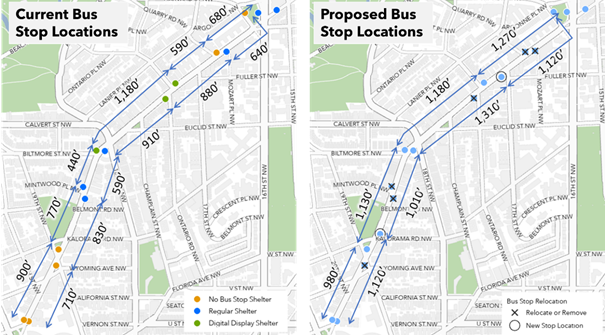
I'm sorry to all the seniors who won't be able “to adjust” to having less access to bus stops as our Councilmember suggests below.  Or for those with disabilities. Or families.

I'm sorry we now have less bus stops based on some arbitrary reading of statistics by some bureaucrats and interns at DDOT with no bearing on living in cities, let along a congested very busy commercial corridor like ColRd.

I'm sorry the DC Office of “Planning” has pushed #buildmore inducing substantial population growth (displacement & replacement) with no impact study all while cutting public transportation options.

I'm sorry that all of these fools have broken our city.

No thanks!

Chris O.

———- Forwarded message ———
From: Nadeau, Brianne K. (Council) <BNadeau@dccouncil.gov>
Date: Thu, Sep 19, 2024 at 4:55 PM
Subject: RE: Councilmember — Seeking Assistance —> Fwd: Thanks, One last clarification —> Re: Capricious & Harmful Re: [adamsmorgan] On the Col Rd plan: Class of People Most Impacted
To: Chris R. Otten <crotten2@gmail.com>
Cc: Meni, David (Council) <dmeni@dccouncil.gov>, Rivero, Niccole (Council) <nrivero@dccouncil.gov>, Nava, Maricela (Council) <mnava@dccouncil.gov>

Hi Chris. I received your message.


Whenever bus stops are change, it can be difficult for people to adjust at first. But this project will have a positive impact on bus riders because it is making the route more reliable and safe. There was a great deal of community engagement on the project, and I have been closely monitoring its implementation.


All the best,


Brianne


From: Chris R. Otten <crotten2@gmail.com>
Sent: Thursday, September 19, 2024 4:39 PM
To: Nadeau, Brianne K. (Council) <BNadeau@dccouncil.gov>
Cc: Meni, David (Council) <dmeni@dccouncil.gov>; Rivero, Niccole (Council) <nrivero@dccouncil.gov>; Nava, Maricela (Council) <mnava@dccouncil.gov>
Subject: Re: Councilmember — Seeking Assistance —> Fwd: Thanks, One last clarification —> Re: Capricious & Harmful Re: [adamsmorgan] On the Col Rd plan: Class of People Most Impacted


Will anyone at least acknowledge receipt of the email?


On Wed, Sep 18, 2024 at 11:48AM Chris R. Otten <crotten2@gmail.com> wrote:

Dear Councilmember Nadeau,

I hope you are well and settling back into the fall Council session.

I’m reaching out regarding the Columbia Road Bus Priority project, which has generated significant concern among Ward 1 residents. I’ve been following this issue closely, as reflected in my correspondence with DDoT (included below), and I am troubled by the proposed elimination of bus stops along this busy commercial corridor.

The removal of these stops will have a particularly harmful impact on our most vulnerable neighbors—seniors, people with disabilities, and families with young children—many of whom rely heavily on accessible public transit. Given these concerns, I’m wondering if you might be able to weigh in on the issue.

It’s difficult to reconcile the city's push for increased housing density with simultaneous cuts to public bus access and services, which seem to run counter to the needs of a growing population. 

Your perspective and involvement could make a meaningful difference in addressing these concerns, and I hope you are working to assess the impact this project will have on our community.

Thank you for your time and consideration.

Chris Otten
Adams Morgan


———- Forwarded message ———
From: Chris R. Otten <crotten2@gmail.com>
Date: Mon, Jul 29, 2024 at 5:57PM
Subject: Re: Thanks, One last clarification —> Re: Capricious & Harmful Re: [adamsmorgan] On the Col Rd plan: Class of People Most Impacted
To: Harrison, Kevin (DDOT) <Kevin.Harrison@dc.gov>
Cc: Carrington, James (DDOT) <james.carrington@dc.gov>, Sandra Reischel <sandrareischel@yahoo.com>, Virginia Johnson <dcvirginia@hotmail.com>


I'm sending this one last time. Mr. Harrison,


Are you ok?


Hoping to get one last answer below.

Please clarify perhaps why again you and DDoT may be using the “average” bus stop spacing number universally across the city regardless of “land uses” and density of any given area.  The result is less bus access to the very busy dense commercial corridor along Columbia Road for example.


Chris Otten


On Thu, Jul 25, 2024 at 1:33PM Chris R. Otten <crotten2@gmail.com> wrote:

Kevin?


On Mon, Jul 22, 2024 at 1:52PM Chris R. Otten <crotten2@gmail.com> wrote:

Kevin, Hi.


Please if you can rebut or send me an answer to what appears as my conclusion:


DDoT seems to be suggesting (through you as their representative) that the average bus stop spacing number is somehow a universal number to be applied anywhere in the city similarly, making the average bus stop spacing the absolute bus stop spacing for the whole city.


Whereas the report you cited doesn't reference averages to be used universally across the city. Rather, The addition or subtraction of bus stop locations need to take into consideration the existing transit network, trip generators, land uses, and pedestrian infra structure. Bus stops need to have adequate sidewalk connections and roadway crossing amenities (i.e. marked crosswalks, median islands, curb ramps, pedestrian signals, etc.).”


Please clarify perhaps for the last time why again you and DDoT may be using the “average” bus stop spacing number universally regardless of “land uses” and density of any given area.


This is a concern, because you are eliminating bus stops on the very busy commercial Columbia Road corridor making it harder to access the bus services for elders, families, and others.


Thanks.

Chris


On Mon, Jul 15, 2024 at 4:32PM Chris R. Otten <crotten2@gmail.com> wrote:

Thanks Kevin. For the explanation.


Ok, So I've read the link you've given me from 15 years ago.


At page 6. I think is the rub:


Accessibility Factors
The recommended bus stop spacing should serve as a guide. The addition or subtraction of bus stop locations need to take into consideration the existing transit network, trip generators, land uses, and pedestrian infra structure. Bus stops need to have adequate sidewalk connections and roadway crossing amenities (i.e. marked crosswalks, median islands, curb ramps, pedestrian signals, etc.).


The above section of the 2009 report you've given as substantiation for eliminating bus access in Adams Morgan is very important.


It explains why most jurisdictions including DC up to now don't simply average bus stop spacing and apply it universally across the whole city independent of land use needs (busy denser commercial corridor versus less denseresidential thru way).  


DC and most cities reference an average number for their bus spacing.  So in more dense areas the bus stop spacing is shorter and in more residential less dense thru ways the bus stop spacing is greater and they come up with an average.


But now, DDoT seems to be conflating this average numbers as some sort of holy grail number. That is DDoT and you seem to be suggesting the average spacing is somehow a universal number to be applied anywhere in the city similarly, making the average bus stop spacing the absolute bus stop spacing for the whole city.


The result as suggested at page 6 is a reduction in accessibility esp along DC's commercial corridors, thus forcing residents to choose other transit than bus. Likely a car. Thus defeating the whole point of a “Better Bus System.”


Please tell me I'm wrong and that you won't be eliminating bus accessibility along Columbia Road.


Thank you.


On Mon, Jul 15, 2024 at 4:10PM Harrison, Kevin (DDOT) <Kevin.Harrison@dc.gov> wrote:

Hi Mr. Otten,


Here are responses to you questions:


  1. Wait, we were just emailing, now you aren't at your desk until Monday?

Sorry, I leave work at about 5:30 most days and I was off on Friday.


  1. Would it be the DDoT's position that the same bus stop spacing applies to say upper 16th street north of Arkansas, versus Columbia Road between 18th and 16th?

For the S2, yes. The S9 is limited stop service so the spacing is longer.


  1. And, that the singular universal number bus stop spacing in DC is grounded because NYC does it that way?

No.


  1. If at all possible, please explain more and I will most understand what you are saying.

I recommend taking a look at WMATA’s “Guidelines for the Design and Placement of Transit Stops” from 2009. Page 5 provides more information and also some related research for further reading about bus stop spacing standards.


Thanks!


Kevin


From: Chris R. Otten <crotten2@gmail.com>
Sent: Friday, July 12, 2024 1:56 PM
To: Harrison, Kevin (DDOT) <Kevin.Harrison@dc.gov>; Carrington, James (DDOT) <james.carrington@dc.gov>
Cc: Sandra Reischel <sandrareischel@yahoo.com>; Virginia Johnson <dcvirginia@hotmail.com>
Subject: Re: Capricious & Harmful Re: [adamsmorgan] On the Col Rd plan: Class of People Most Impacted


CAUTION: This email originated from outside of the DC Government. Do not click on links or open attachments unless you recognize the sender and know that the content is safe. If you believe that this email is suspicious, please forward to phishing@dc.gov for additional analysis by OCTO Security Operations Center (SOC).


Please respond Mr. Harrison or Mr. Carrington if at all possible.


Thank you.


On Thursday, July 11, 2024, Chris R. Otten <crotten2@gmail.com> wrote:


Wait, we were just emailing, now you aren't at your desk until Monday?


Please Mr. Harrison, I truly want to understand DDot's position.


Would it be the DDoT's position that the same bus stop spacing applies to say upper 16th street north of Arkansas, versus Columbia Road between 18th and 16th?


And, that the singular universal number bus stop spacing in DC is grounded because NYC does it that way?


If at all possible, please explain more and I will most understand what you are saying.


Thanks,

Chris


———- Forwarded message ———
From: Harrison, Kevin (DDOT) <Kevin.Harrison@dc.gov>
Date: Thu, Jul 11, 2024 at 6:25PM
Subject: Automatic reply: Capricious & Harmful Re: [adamsmorgan] On the Col Rd plan: Class of People Most Impacted
To: Chris R. Otten <crotten2@gmail.com>


Hi, I'm out of the office and unable to respond to email, but I will reply when I'm back at my desk— Monday, July 15.


If it's urgent, please email james.carrington@dc.gov.


Kevin


Kevin Harrison
Transportation Planner

Transit Delivery Division
District Department of Transportation
250 M Street SE
Washington, DC 20003

m. 202.848.8829

f. 202.671.0617
e. kevin.harrison@dc.gov

w. ddot.dc.gov


On Thu, Jul 11, 2024 at 6:21PM Chris R. Otten <crotten2@gmail.com> wrote:

So I want to understand as best I can Mr. Harrison.

Are you saying that parts of DC are not more residential and not more commercial?

Compare say upper 16th street north of Arkansas, versus Columbia Road between 18th and 16th.

Yet, would it be the DDoT's position that the same bus stop spacing applies?


And it seems you are comparing DC to New York, is that right?


On Thu, Jul 11, 2024 at 5:35PM Harrison, Kevin (DDOT) <Kevin.Harrison@dc.gov> wrote:

Hi Mr. Otten,


As I previously stated, the basic geometry of how people get to a bus stop does not change with increased population density. It remains a balance areas of duplicative coverage (slow) with coverage gaps (fast). I know that many jurisdictions have different stop spacing standards for suburban and urban locations, but that is primarily to account for sparse development and poorly connected street grids in suburban places. Take a look at Colesville Rd in MD or Wiehle Ave in VA for example.


New York City is implementing the same stops spacing as the District. The spacing between stops may increase for certain bus service types (local, express, etc.), but for local service they are recommending ¼ miles spacing, about the same as WMATA, regardless of land use. Except in some cases (similar to my description above) the distance may increase because , “The surrounding land use makes adding a stop infeasible (e.g. large parks, bridges, tunnels, busy or extensive driveways).”


I hope this information is helpful.


Thank you,


Kevin


From: Chris R. Otten <crotten2@gmail.com>
Sent: Thursday, July 11, 2024 5:13 PM
To: Harrison, Kevin (DDOT) <Kevin.Harrison@dc.gov>
Cc: Sandra Reischel <sandrareischel@yahoo.com>
Subject: Re: Capricious & Harmful Re: [adamsmorgan] On the Col Rd plan: Class of People Most Impacted


CAUTION: This email originated from outside of the DC Government. Do not click on links or open attachments unless you recognize the sender and know that the content is safe. If you believe that this email is suspicious, please forward to phishing@dc.gov for additional analysis by OCTO Security Operations Center (SOC).


Mr. Harrison,

You have explained that DDoT is using an universal standard for bus stop spacing — about one stop every 322 meters or 1057 feet (5 bus stops every mile); So according to the DDoT claim, there is some universal standard requiring one stop every 322 meters.


And that this singular universal standard is being applied to Columbia Road NW and the result between 18th and 16th Street is an elimination of an existing bus stop from 2 down to 1.  Thus shrinking access to bus services along this dense commercial corridor.


My question is why is DC using this singular universal standard for bus stop spacing citywide no matter the density of any given route (commercial higher density corridor versus more residential pass thru corridor) when most major cities use a formula with a direct relationship of bus stop spacing to density as shown here: https://findingspress.org/article/27373-distributions-of-bus-stop-spacings-in-the-united-states


On Thu, Jul 11, 2024 at 4:12PM Harrison, Kevin (DDOT) <Kevin.Harrison@dc.gov> wrote:

I’m sorry. I don’t think I understand your question:


“Why is DC the only city I can find that has some universal standard regardless of the types of use of the areas being served. Im curious?”


Can you please clarify?


Thanks,


Kevin


From: Chris R. Otten <crotten2@gmail.com>
Sent: Thursday, July 11, 2024 3:40 PM
To: Harrison, Kevin (DDOT) <Kevin.Harrison@dc.gov>
Cc: Sandra Reischel <sandrareischel@yahoo.com>
Subject: Re: Capricious & Harmful Re: [adamsmorgan] On the Col Rd plan: Class of People Most Impacted


CAUTION: This email originated from outside of the DC Government. Do not click on links or open attachments unless you recognize the sender and know that the content is safe. If you believe that this email is suspicious, please forward to phishing@dc.gov for additional analysis by OCTO Security Operations Center (SOC).


Including now. 

On Thursday, July 11, 2024, Chris R. Otten <crotten2@gmail.com> wrote:

Will you please respond Mr. Harrison?


I'm including an elder who will be harmed.


Please respond.


Thank you.


Chris Otten

On Wednesday, July 3, 2024, Chris R. Otten <crotten2@gmail.com> wrote:

Why is DC the only city I can find that has some universal standard regardless of the types of use of the areas being served. Im curious?


On Tuesday, July 2, 2024, Harrison, Kevin (DDOT) <Kevin.Harrison@dc.gov> wrote:

Hi Mr. Otten,


WMATA’s Bus Stop Guidelines (page 5) recommend four to five stops per mile, which equals 1,060’ to 1,320’ between stops. I’ll also note that this standard is being rolled out across the District through the Bus Network Redesign as described here: https://betterbus.wmata.com/downloads/Bus%20Stop%20Consolidation%202024-05.pdf


I think this article provides a useful description of the geometry around stop spacing: https://humantransit.org/2010/11/san-francisco-a-rational-stop-spacing-plan.html


That basic geometry does not change with increased population density. It remains a balance areas of duplicative coverage (slow) with coverage gaps (fast). I know that many jurisdictions have different stop spacing standards for suburban and urban locations, but I think that is primarily to account for poorly connected street grids in suburban places where there is no reason to have a stop for very long stretches along Colesville Rd in MD or Wiehle Ave in VA for example.


One interesting anecdote is that I have been told, but cannot confirm is that the bus stops on Columbia Rd were established when the streetcar was operating there. During that time, the streetcar only had to be faster than walking to be an attractive option. Now that the city is larger and the travel environment has changed, it only makes sense to update the spacing.


Thank you,


Kevin


From: Chris R. Otten <crotten2@gmail.com>
Sent: Tuesday, July 2, 2024 12:07 PM
To: Harrison, Kevin (DDOT) <Kevin.Harrison@dc.gov>
Subject: Re: Capricious & Harmful Re: [adamsmorgan] On the Col Rd plan: Class of People Most Impacted


CAUTION: This email originated from outside of the DC Government. Do not click on links or open attachments unless you recognize the sender and know that the content is safe. If you believe that this email is suspicious, please forward to phishing@dc.gov for additional analysis by OCTO Security Operations Center (SOC).


You don't often get email from crotten2@gmail.com. Learn why this is important

Mr  Harrison,

Thanks for this response

Plesae help ne understand how you derived a standard of:

 
1,060’ to 1,320’ between stops.


Where does this source from.


Alsodoes this standard change at all basedon the land use description of the area the bus maybe serving at any given time, i.e. a bus traversing a residential thruway versus a denser mixed use commercial area?


Thanks forhelp.


Chris


On Tuesday, July 2, 2024, Harrison, Kevin (DDOT) <Kevin.Harrison@dc.gov> wrote:

Hi Mr. Otten,


DDOT takes bus stop locations very seriously and recognizes that these new bus stop locations will be an inconvenience for some people. However, there will still be a bus stop within a block and a half of any location on Columbia Road and this relocation will reduce travel time and improve reliability for all bus riders.


National best practice and WMATA bus stop placement guidelines recommend four or five stops per mile (i.e., 1,060’ to 1,320’ between stops) for local bus service to balance easy access to bus stops with efficient service. The proposed bus stop rebalancing would increase average stop spacing from 760’ to 1,140’, which is a distance that optimizes access to bus stops and reduced bus travel times. These bus stop moves also support safety goals of the project by placing the stops near signalized intersections, which are easier for crossing the street, and at the far side of intersections to improve visibility for people riding bikes and reduce right-turn conflicts.


The image below shows the current and proposed location of bus stops on Columbia Road NW and the NOI contains more information about the relocations.

Graphical user interface, diagram, application
Description automatically generated


Thanks,


Kevin


From: Chris R. Otten <crotten2@gmail.com>
Sent: Monday, July 1, 2024 6:53 PM
To:
adamsmorgan@groups.io
Cc: Harrison, Kevin (DDOT) <
Kevin.Harrison@dc.gov>
Subject: Capricious & Harmful Re: [adamsmorgan] On the Col Rd plan: Class of People Most Impacted


CAUTION: This email originated from outside of the DC Government. Do not click on links or open attachments unless you recognize the sender and know that the content is safe. If you believe that this email is suspicious, please forward to phishing@dc.gov for additional analysis by OCTO Security Operations Center (SOC).


You don't often get email from crotten2@gmail.com. Learn why this is important

I'm hoping Mr. Harrison, who I've cc'd and have been looping in prior emails can weigh in here.


So Lance's issues aside, I agree that more bike (rollerblading) lanes are great if they are planned as part of an overall strategy to INCREASE multimodal access to get around our city safely.


To the point I was raised when starting out this thread: 


I simply cannot find nor fathom I will find any documentation or anyone who says decreasing bus access (i.e. eliminating bus stops) makes any sense especially along this busy commercial mixed use stretch of Adams Morgan. 


So while bike lanes benefit the public generally, what is harmful is eliminating bus stops while increasing growth/density (see 1617 U Street for example). This isn't so smart and hurts those pedestrians who rely on bus stop proximity.


I believe those who have bad feet, or a creeky back, or are using walkers or have any kind of disability whatsoever should be as prioritized as those able to ride bikes.


Instead, what we are witnessing is a DECREASE in bus service access (bus stops) that harms the class of people in our neighborhood that I describe above.


As the APA explains: “Despite good intentions, planners and architects tend to design for the mythical five-foot-10, 175-pound, nondisabled male.” https://www.planning.org/planning/2016/mar/designforeverybody/


This is especially troubling because the other great bus planning ideas of putting buses in their own lanes and having bus stops projected out and situated across intersections is already known to speed up the trips.  So then why eliminate access to those speedier bus trips especially for those who rely on that access now.


It seems wildly capricious and out of balance.


Chris O.


On Mon, Jul 1, 2024 at 6:11PM jeffrey w comer via groups.io <comer.jeffrey=gmail.com@groups.io> wrote:

Lance's argument is that bikes are toys that are better suited for weekends and bike trails. Bicycles are not part of the multimodal transportation model that is common in growing, thriving urban areas. He has said as much here multiple times. 


More generally, the take is that WABA — the cycling lobby — is severely criticised for lobbying for cyclists. I still can't figure that one!?!


It's not a convincing argument at all and given the number of cyclists I see on a daily basis, it's myopic. Moving people through the network, no matter the mode, and with a minimal carbon footprint, should be the priority. 


On Mon, Jul 1, 2024, 17:13 Maria Felenyuk via groups.io <maria.felenyuk=gmail.com@groups.io> wrote:

Lance, 


What is your actual argument? All the bike lanes, except for one block in front of Safeway, already exist. Do you want DDOT to get rid of them? 


 And the official project name is Bus Priority AND Protected bike lanes. It's not a secret, and they aren't trying to sneak anything. 


On Mon, Jul 1, 2024 at 4:56PM lance via groups.io <salonial=aol.com@groups.io> wrote:

A bus priority project that doesn’t prioritize buses but is used instead as an excuse to stealthily build more bike lanes isn’t a compromise.  It’s a sham.  

And you’re going to have to accept that because it’s a sham, we’re going to stop it like we stopped the shams on K Street and Connecticut Avenue.  You’re going to have to accept that you’re no longer going to get things just because you want them.  Spoiled child days are over. 


_._,_._,_


Groups.io Links:

You receive all messages sent to this group.

View/Reply Online (#65367) | Reply To Group | Reply To Sender | Mute This Topic | New Topic


Welcome to the Adams Morgan listserv, founded by JB Fields and Josh Gibson on October 26, 1999. RIP, J.
Onelist begat EGroups begat Yahoo Groups begat Groups.io
List Administrators: Josh Gibson and George Schmitt.
In Adams Morgan we trust.


Your Subscription | Contact Group Owner | Unsubscribe [crotten2@gmail.com]

_._,_._,_

PRESS RELEASE AND NEW REPORT FROM AUDITOR’S OFFICE ON INCLUSIONARY ZONING

This November 20, 2024, report by the Office of the Auditor on DC’s Inclusionary Zoning program is an indictment of the Smart Growth urbanists who say that building more luxury housing with a required handful of IZ units would be an answer to our unaffordable housing crisis.  The numbers in the official report below show quite the opposite.
 
WE NEED AN ALTERNATIVE THAT DECOMODIFIES HOUSING AND AFFIRMS THAT HOUSING IS A HUMAN RIGHT!
 
biznassman_profiting_from_luxury_housing_on_public_land1.jpg
Part of the IZ failure is because the so-called YIMBY urbanist originators of this alleged “affordable” housing policy chose to never highlight the lack of accountability and enforcement of their developer real estate friends in any of their testimony to the Zoning Commission and to the Council over the years.
 
For more than a decade now, IZ has been used as the soapbox for YIMBYs to cheer on upzoning such as at 1617 U Street.  IZ has been the guise for luxury overdevelopment since 2009 and destroyed affordability in the District by setting the definition of “affordable housing” so high as to be out of reach of most working people and families in our city.
 
Resources/Background:
Below find my highlights from the Auditor’s Report including the two big takeaways showing the dire and acute need for an alternative like social housing:
  • 18,000 people on the waitlist for 2000 IZ units!
  • Of the 2000 IZ units, 1300 of them are for single individuals (65%).
  • Most of the IZ waiting list consists of family-sized households needing 3+ bedrooms.
  • Some of the current IZ participating households are spending 50% of their income on housing costs (this is unlawfully not affordable).
  • IZ units are allowed to sit vacant allowing the developers to gain luxury density while keeping empty the pitiful handful of IZ units they are required to fill.
  • Of the IZ units that are being filled, it takes an IZ participant on average 13 months to move-in to the unit.

The Auditor’s press release was rosy compared to the actual underlying data, see screenshots
of major findings directly from the report:
 
Screenshot_2024-11-22_20-02-24.jpgScreenshot_2024-11-22_20-05-02.jpgScreenshot_2024-11-22_20-06-01.jpg
Screenshot_2024-11-22_20-06-38.jpg

Screenshot_2024-11-22_20-07-15.jpg

Screenshot_2024-11-22_20-07-49.jpg

Screenshot_2024-11-22_20-111.jpg


On Fri, Nov 22, 2024 at 7:48 PM Debby Hanrahan <debbyhanrahan@yahoo.com> wrote:
Hello all,
The only thing I can say after a quick read of this City Auditor’s new report is that the inclusionary zoning (IZ) program is as bad as we have suspected and have witnessed on an anecdotal and individual project basis. The financial abuses of the program were not highlighted, but I hope that will come soon. After you have a chance to read this, I hope you will feel free to walk into your nearest IZ-participating project and ask about subsidized units.
Best,
Debby
—– Forwarded Message —–
From: Patterson, Kathy (ODCA) <kathy.patterson@dc.gov>
To: Debby Hanrahan <debbyhanrahan@yahoo.com>
Sent: Wednesday, November 20, 2024 at 12:56:46 PM EST
Subject: FW: New report: Stronger Oversight Needed for Inclusionary Zoning Program to Reach Housing Goals

Just posted; thanks for your interest!

Kathleen Patterson  |  D.C. Auditor

she/her/hers

Office of the D.C. Auditor

1331 Pennsylvania Avenue NW 8th Floor

Washington D.C. 20004

Direct: (202) 727-8982  | Office: (202) 727-3600

Email: kathy.patterson@dc.gov

Website: www.dcauditor.org

From: Shinn, Diane (ODCA) <diane.shinn@dc.gov>
Sent: Wednesday, November 20, 2024 12:48 PM
To: Shinn, Diane (ODCA) <diane.shinn@dc.gov>
Subject: New report: Stronger Oversight Needed for Inclusionary Zoning Program to Reach Housing Goals

Good morning. Attached please find our newest press release and report entitled Stronger DHCD Oversight Needed for Inclusionary Zoning Program to Reach Housing Goals.

Despite a lack of enforcement that has enabled a culture of non-compliance at some of its properties, the District’s Inclusionary Zoning program—

one of the many pathways toward the city’s affordable housing goals—has already implemented or is implementing many recommendations of a new audit published today by the Office of the D.C. Auditor (ODCA).

The IZ program’s purpose is to use market-rate development to increase affordable unit production and ultimately create a full range of long-term housing choices for each District household regardless of size and income. Mayor Muriel Bowser is aiming to achieve the affordable housing goal of producing 12,000 new affordable units for D.C. residents by 2025.

Actions taken by the Department of Housing and Community Development (DHCD) included enforcement action against an IZ provider following a Management Alert issued by ODCA in June.

“We were pleased at the immediate action the agency took earlier this year,” said D.C. Auditor Kathy Patterson. “We are pleased with DHCD’s concurrence with nearly all 17 of ODCA’s recommendations aimed at improving the IZ program’s efficacy, including efforts to meet the 102-day target to fill IZ units from what an ODCA sample found was an average of more than 13 months.”

Findings in the report include that during the audit’s scope DHCD did not:

•            Ensure that annual reporting requirements were enforced, which meant they were not able to track which units were vacant or who was living in occupied units.

•            Ensure that IZ tenants’ incomes were recertified annually which potentially allowed participants to remain in IZ units for which they were no longer eligible because their income exceeded their units’ income requirement.

•            Ensure that properties submitted renewal leases annually. Of the IZ properties in the report’s sample, only one of 16 properties was found to have completed lease renewals in a timely manner. At six of the properties, some renewed leases were found and those, on average, were dated 147 days (five months) after the previous lease’s expiration date. The remaining properties had not renewed any leases at the time of ODCA’s site visits, putting the tenants into a month-to-month status on an expired lease.

•            Initiate enforcement action against property owners who violated IZ development covenant requirements and DCMR.

Please let me know if you’d like to speak to the Auditor about this report. Thanks for your interest in ODCA’s work.


Diane Shinn | Director of Communications

Office of the D.C. Auditor

1331 14th Street N.W., Suite 800 South

Washington, DC  20004

Direct: (202) 727-8991 | Office: (202) 727-3600 | Cell: 202-255-6717

she/her/hers

diane.shinn@dc.gov

dcauditor.org

Auditude

@ODCA_DC