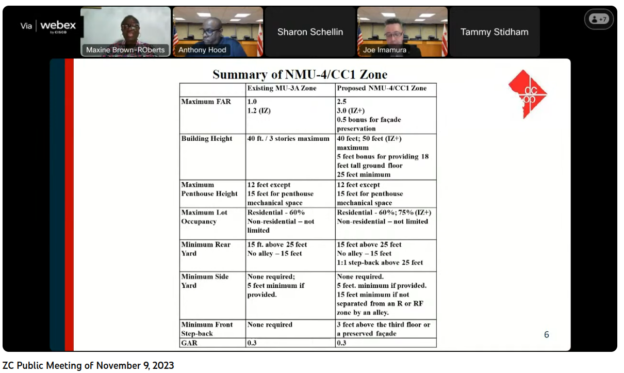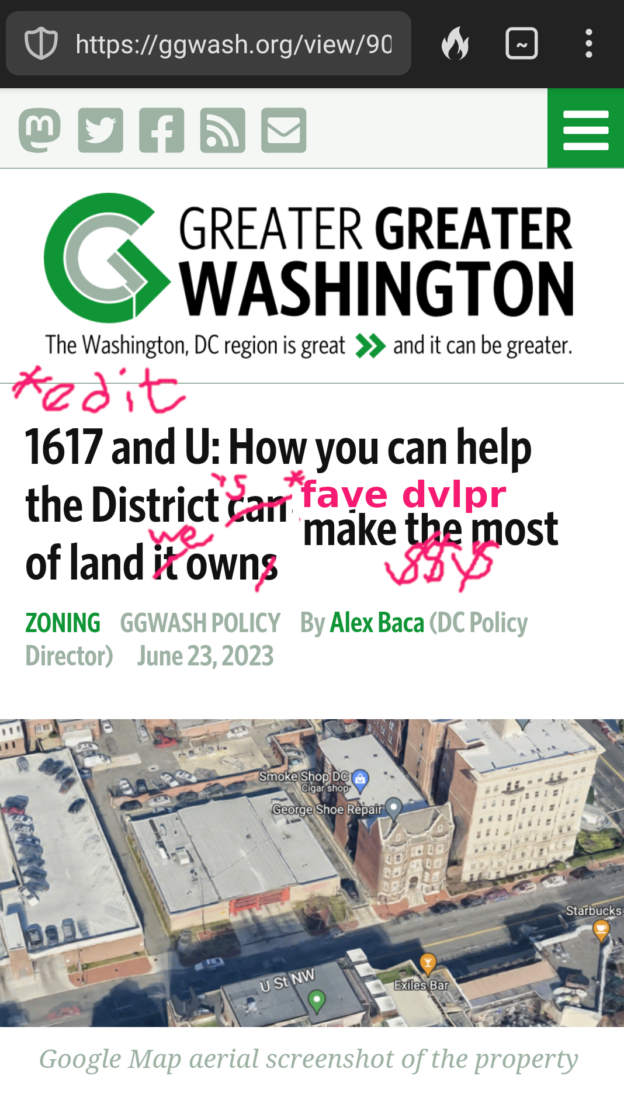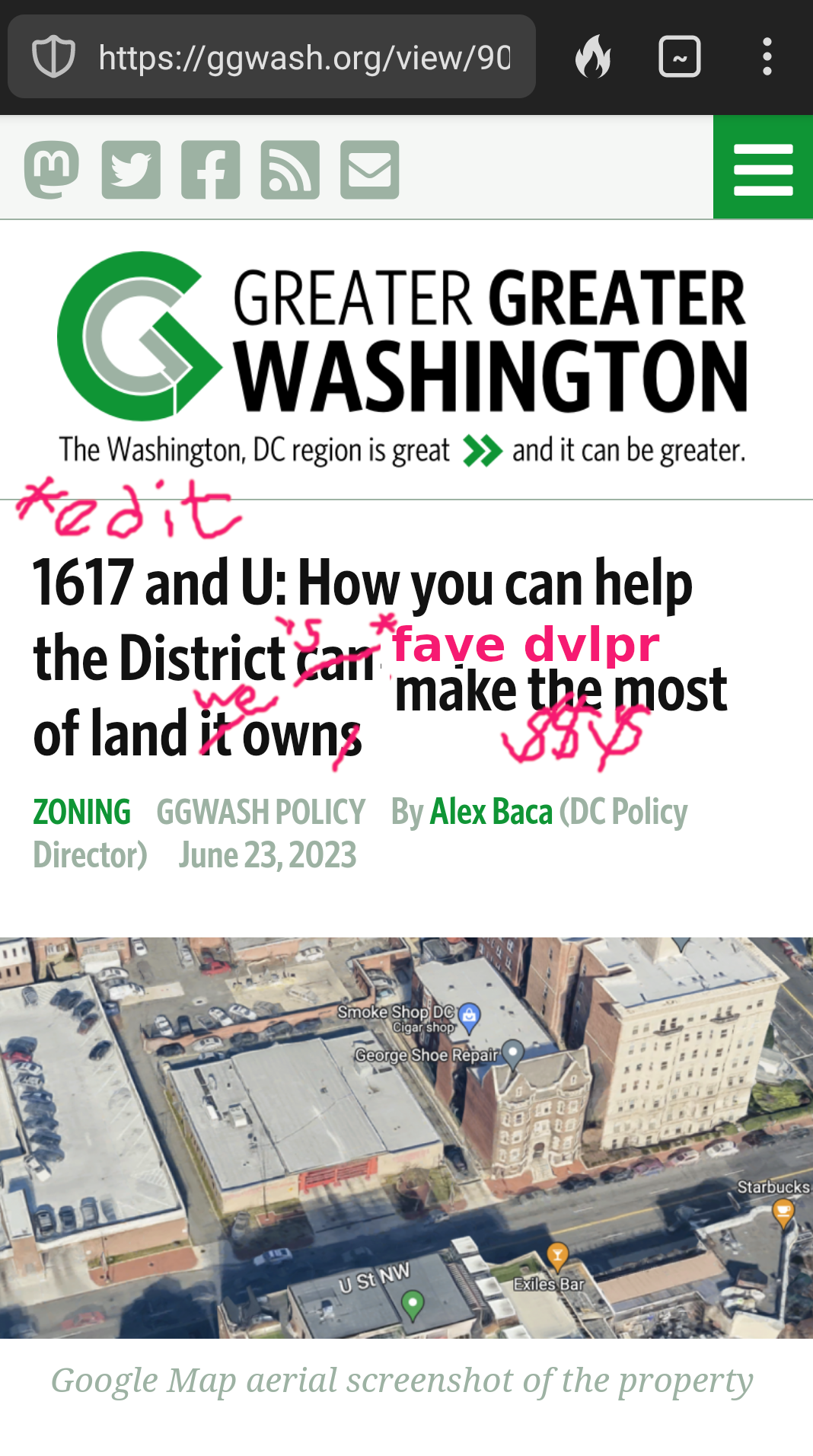
Wards 1 & 2, Washington, DC — The Mayor has applied to rezone 2-acres of public land at 1617 U Street NW to allow 10+ story buildings at the public site in an area surrounded by two- and three-story historic districts with rowhomes dating back to the 1800's.
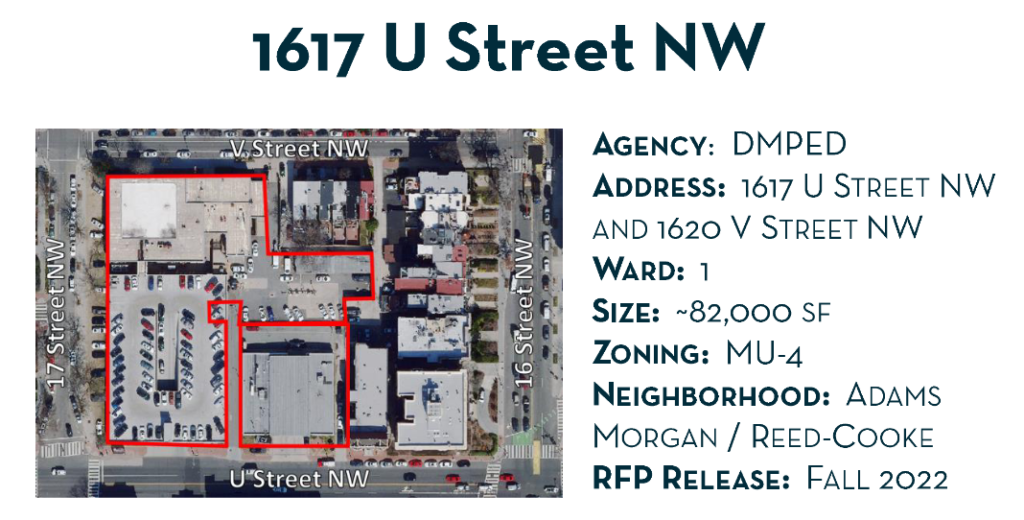
Despite the clamoring of opposition and desire for more engagement on the future of 1617 U Street, according to a neighbor's letter to the DC Council and a party's motion sent to the DC Zoning Commission showing that
the Mayor's Office of Planning and DC Office of Zoning have chosen to use outdated mailing lists that has left off numerous neighbors and properties from engagement, eliminating their opportunity to part of the zoning case and hearing this coming Monday, January 8, 2024.A motion filed with the Zoning Commission by neighbors says:
In all more than 40 different Property Owners within 200 feet of this site were not provided the legally required notice of the January 8, 2024 Hearing required under 11 DCMR, Subtitle Z, §402.1(d) nor did this Commission inform these 40+ Property Owners of “The requirements for participation as a party” and the importance of that status in a contested case, as required by 11 DCMR, Subtitle Z, §402.2. This upzoning is the prelude to DMPED’s attempt to have a massive 11 story, 650 unit apartment building constructed on this site. Failure to grant Property Owners their due process rights under the Subtitle Z in this contested case, is not only fundamentally wrong but will likely cause extensive and unnecessary future litigation.
Neighbors are asking the Zoning Commission to rule on the motion asking for postponement until proper and full notice is sent to all affected neighbors per the zoning regulations.
### ###
From: Arlene Feskanich <feskanicha@gmail.com>
Date: Fri, Jan 5, 2024 at 1:20 PM
Subject: Office of Zoning Case 23-02: Joint Motion to Continue January 8, 2024 Hearing Due to Failure to Properly Notify All Property Owners Within 200 Feet & Mailing List Used to Serve Property Owners Was from 2022 (or Earlier)
To: <abonds@dccouncil.gov>, bnadeau@dccouncil.gov <bnadeau@dccouncil.gov>, <bpinto@dccouncil.gov>, <callen@dccouncil.gov>, <chenderson@dccouncil.gov>, <jlewisgeorge@dccouncil.gov>, <kmcduffie@dccouncil.gov>, mfrumin@dccouncil.gov <mfrumin@dccouncil.gov>, <pmendelson@dccouncil.gov>, <rwhite@dccouncil.gov>, <twhite@dccouncil.gov>, <vgray@dccouncil.gov>, <zparker@dccouncil.gov>
CC: Arlene Feskanich <feskanicha@gmail.com>, Edward Hanlon <ed.hanlon.3@gmail.com>, Gregory Adams <adams.gregory1@yahoo.com>, Randy Jones <rjj0302@gmail.com>, Schellin, Sharon (DCOZ) <sharon.schellin@dc.gov>
From: ed.hanlon.3@gmail.com <ed.hanlon.3@gmail.com>
Sent: Thursday, January 4, 2024 4:01 PM
To: 'Daniel.Lyons@dc.gov' <Daniel.Lyons@dc.gov>; 'Jennifer.Steingasser@dc.gov' <Jennifer.Steingasser@dc.gov>; 'Joel.Lawson@dc.gov' <Joel.Lawson@dc.gov>; 'dcoz@dc.gov' <dcoz@dc.gov>; 'Brian (OAG' <Brian.Schwalb@dc.gov>; 'oag@dc.gov' <oag@dc.gov>; 'Alexandra (OAG' <Alexandra.Cain@dc.gov>; 'Lily (OAG' <lily.bullitt@dc.gov>; 'Maximilian.Tondro@dc.gov' <Maximilian.Tondro@dc.gov>; 'Niquelle.Allen@dc.gov' <Niquelle.Allen@dc.gov>; 'Johnnie.Barton2@dc.gov' <Johnnie.Barton2@dc.gov>; 'ashley.cooks@dc.gov' <ashley.cooks@dc.gov>; 'odca.mail@dc.gov' <odca.mail@dc.gov>; 'jlewisgeorge@dccouncil.gov' <jlewisgeorge@dccouncil.gov>; 'oca.eom@dc.gov' <oca.eom@dc.gov>; 'dmped.eom@dc.gov' <dmped.eom@dc.gov>; 'planning@dc.gov' <planning@dc.gov>; 'sharon.schellin@dc.gov' <sharon.schellin@dc.gov>; 'DCOZ – ZC Submissions (DCOZ' <DCOZ-ZCSubmissions@dc.gov>; '1b@anc.dc.gov' <1b@anc.dc.gov>; '2B@anc.dc.gov' <2B@anc.dc.gov>
Subject: Joint Motion to Continue January 8, 2024 Hearing Due to Failure to Properly Notify All Property Owners Within 200 Feet & Mailing List Used to Serve Property Owners Was from 2022 (or Earlier)
JOINT MOTION OF DUPONT CIRCLE CITIZENS ASSOCIATION,
HOMEOWNERS WITHIN 200 FEET OF LOTS 826 AND 827 AND RANDALL JONES
REQUESTING THE COMMISSION CONTINUE THE JANUARY 8, 2024 HEARING DUE TO
FAILURE TO PROPERLY NOTIFY ALL PROPERTY OWNERS WITHIN 200 FEET
—- continued on the record —-
———– click link above ——–
 Joint-Motion-to-Continue-January-8-2024-Hearing-Due-to-Failure-to-Properly-Notify-All-Property-Owners-Within-200-Ft.pdf