MW COG

MW COG SETS 2030 HOUSING NUMBERS

UPDATE ON SEP. 11, 2019, MEETING AT METRO WASHINGTON COUNCIL OF GOVERNMENTS (COG) REGARDING HOUSING IN THE DMV THROUGH 2030

On September 11, 2019, the COG passed a joint resolution that sets into motion the coordination of housing preservation and production targets across the DMV. The goal: 320,000 new or preserved housing units by 2030, and of these 2/3 of the units should be considered “affordable.” Chair of the COG, DC City Councilmember, Robert White, emphasized that these units should be built to include 3+ bedroom units, aka family-sized units.

Find the COG documentation and resolution below:

* https://www.mwcog.org/newsroom/2019/09/11/officials-set-regional-housing-targets-call-for-collaboration-to-address-production-and-affordability-challenges/

============================
RESOLUTION R27-2019
============================

Major points:

  • 320K Housing Units Added 2020-2030 (an additional 75,000 units beyond units already forcast)
  • 75% of all new housing should be located in activity centers and around high activity transit (see definitions above)
  • 75% of all new housing should be “affordable” to lower- and moderate-income housing (see definitions above).
  • To share these goals to all constituents and set targets for each jurisdictions.
  • To work with non profit private and philathnropic entities to advance these goals

ROBERT WHITE — AYES UNANIMOUS RESOLUTION MWCOG R27-2019 PASSES SEP 11 2019

============================
DEFINITIONS
============================

In reviewing the resolution and information from the COG about the Housing Production targets please understand the following definitions as they can be interpreted:

  • Accessibility — Locating housing close to transportation, transit centers, or “activity centers.” This term has almost nothing to do with universal accessibility a principle of the disability advocacy community.
  • Affordable Housing — Housing that costs $2,500/m or less. There is no mention of bedroom sizes or housing costs as a percentage of one’s income. It is strictly the government setting levels of profit making, shifting market forces and volatility from the private sector onto the public.

============================
NEWS REPORTS
============================

Some news reports that came out after:

============================
OMISSIONS IN THE DISCUSSION
============================

The following are basic planning concepts that wasn’t discussed at all or just briefly by COG before passing the resolution:

  • Expiring Affordability — What is the duration of affordable covenants that may run with the land? Shouldn’t we be ensuring that any new or preserved affordable housing exist in perpetuity.  What’s the point of expiring affordable housing covenants?
  • Public / Universal Housing — The COG made no mention of the importance of public housing and public land while setting these housing targets.  Public housing is a permanent safety net to prevent homelessness.
  • Analysis of $2500/m — How realistic is it to say “affordable” housing set at $2,500 a month.  Doesn’t this just push the status quo?

============================
SOME QUOTES FROM THE COG MEETING
============================

* CHRISTIAN DORSEY, ARLINGTON, COG — “Ready and willing to do our part” “I love three simplistic targets” “This is a big setp for our region” “Our region has failed to effectively deal with housing” “Its complicated” “Roads are full of traffic” “Net effect people are harmed” “Targets are based on thoughtful analysis” “Provide accountability” “Concept of regionalism should not be understated” “lets get it done, im excited”

* DERRICK DAVIS, PG COUNTY, COG — “we explored, what the heck is ami” “no better place to be than the dmv” quotes victor hoskins … as a great thinker.  “messaging is absolutely important, crucial to drive home, to give politicos the right message to communicate with our folks”

* JOHN FOUST, FAIRFAX — “economic development critical” “Fairfax board has committed to 5,000 units over 15 years”

* NANCY NAVARRO, MOCO — asks about the “defintion of high impact areas” when referencing jbg report; emphasizes “social justice and racial equity”

* JUSTIN WILSON, ALEX — “addressing concerns about impacts such as overcrowding schools”

* BEV PERRY, DC — “more work needs to be done”

* KATE STEWART, TKPK — “Board Retreat was helpful” quotes Matthew Desmond “Its hard to argue that housing is not an fundamental human need” … “we’ve been echoing that sentiment” “this is an historic event today” “wants to partner with Mont County”

* RUTH ANDERSON, PRINCE WILLIAM, — “Cast vote in favor” “this will help us forge our comprehensive plan”

* SENATOR GEORGE BARKER, VA, “we gotta keep stepping things up” “things already happening that are pushing us in the right direction” “fairfax is doing a tremendous job in preservng affordable housing”

* BRIDGET NEWTON, ROCKVILLE — “i think this is wonderful what we are doing with housing” “something mr jackson said, taking over current garden style neighborhoods and that we need to build hi-rises — its a problem. its a quality of life issue, displacement of current families. there’s something to be said about having a balcony, to play outide, etc.” “we don’t need 2 types — hi rise or single family” “we need a mix of housing and therefore we lived in communities with all kinds of careers and picture, and we must look at the whole picture” “climate of fear — when people hear about more housing they immediate fear the impacts to roads and schools”

* TODD TURNER, PG — “impacts that come along with the housing” “what the pressure brings to things like infrastructure” “we have to be very careful about that”

* SHARON BULOVA, FAIRFAX — abt to introduce resolution “region forward compact in 2010” “we’ve had more success in the goals than we’ve realized” ** “our air is better” “we set targets to clean up our air, and we’ve done that.” “amazon — needs affordable housing” “we need to make sure weh have housing and quality of life for the industry we want to attract and retain in our region” “we want to create affordable housing for the folks we want to work here and live here”

===
end
===
#FixPublicHousing now!

2020 Budget SECOND VOTE; Budget Support Act Next

DC4RD report from today’s Legislative meeting at the DC City Council hearing, and the second vote as to the city’s proposed 2020 $15B Budget:

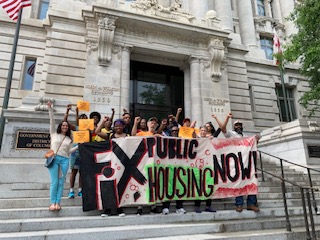
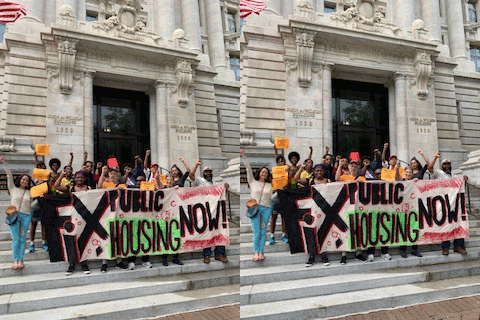
Photo attached of #FIXPUBLICHOUSING now! Rally on the steps of the John A. Wilson building, May 28th, 10AM
#FixPublicHousing now!

#FixPublicHousing now!

Racine’s Tartuffian Endorsement of Silverman in “Opposing Developer Giveaways”

> DC4RD press release :: nov 2 2018 :: contact c.otten 202 810 2768 <<

Racine’s Tartuffian Endorsement of Silverman in “Opposing Developer Giveaways” || UNION MARKET COURT CASE NOV. 13

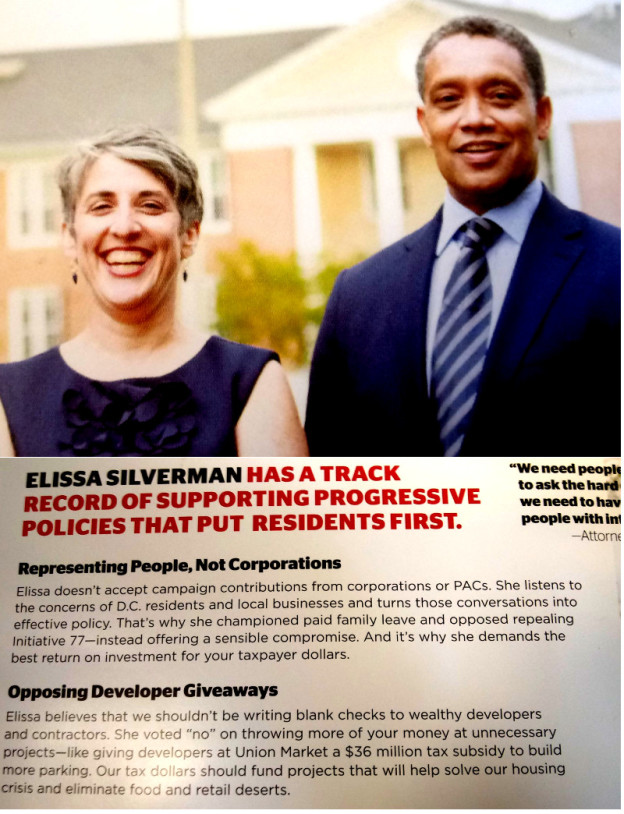
Washington, DC — As election day nears, the mailboxes fill with the latest electioneering propaganda including Elissa Silverman’s latest flyer showing DC’s Attorney General, Karl Racine giving robust endorsement of her at-large campaign.

With rhetoric like “Representing people, not corporations,” and “Opposing developer giveaways,” Racine is full throttle for Silverman while ignoring his own role in promoting corporate developers and giving away significant air-rights entitlements.

On a near weekly basis, Racine’s zoning attorneys provide the now infamous DC Zoning Commission with legal cover to approve major luxury projects citywide, resulting in land use approvals that greatly benefit the bottom-line of the Mayor’s corporate-developer friends while completely ignoring the impacts on existing DC communities and families.

For example, Racine and his zoning lawyers took no issue with the Zoning Commission rubber-stamping hundreds of new luxury hotel rooms & 6,000 new homes across 20 new projects at the blinging new Union Market, with the Office of Planning only brokering 10-units qualifying as “affordable” family-sized (3+ bedrooms) homes.  This type of valuable air-rights giveaway with little in return for existing DC residents holds similarly true for the deals at the Southwest Waterfront and Navy Yard developments, among others.

Racine’s band of top-rate OAG attorneys at the DC Zoning Commission include: Alan Bergstein, Esther Bushman, Hillary Lovick, & Jacob Ritting.  The veteran Alan Bergstein, Esquire, has been plying his trade for more than two decades in DC, directly playing a role in the massive displacement of black residents throughout the city without blinking an eye.

“Racine’s attorneys make it difficult for everyday people and impacted communities to engage in the zoning process and to actually win any permanent equity and compensation out of these disruptive and impactful luxury land deals,” said Ilaf Ayyash who was pushed out of the longtime artists incubator at 411 New York Avenue, NE for a luxury hotel project. “We had to fight just to be heard, and now the OAG is staking claim to the Zoning Commission’s indefensible positions in Court.  It’s such hypocrisy that Mr. Racine decries corporations and land giveaways when that is who his zoning lawyers excel at benefiting.”

Union Market Neighbors will be clashing with Racine’s lawyers again on November 13, 2018, at the highest Court in the District, the DC Court of Appeals, in seeking remedy from impacts due to another massive luxury project at 4th and Florida Avenue, NE. For more info >> http://www.dc4reality.org/unionmarketneighbors

DC Generally a Mess: Timeline

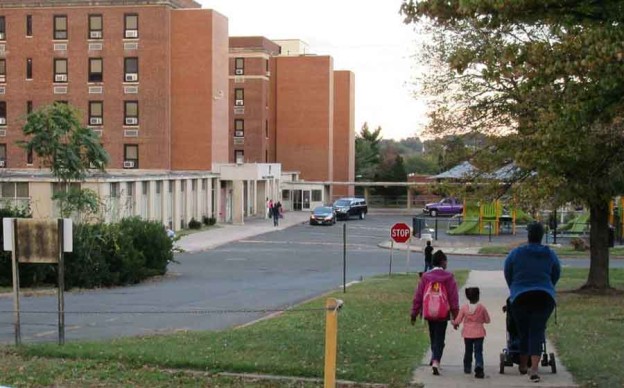
DC General Hospital was hailed as a top emergency trauma center for victims with gunshot wounds, that is until Anthony Williams shut it down as part of the citywide divestment of public services serving working DC residents at the start of the millennium.

2001 – 2013

Over the past decade plus, DC General shifted from a closed hospital to an emergency hypothermia shelter, then to a family shelter as other shelters around the city were shuttered continuing the social service divestment in DC.  The shelter filled up as local politicos luxury-visions for, and gentrification of the city unfolded and homelessness skyrocketed.  Families were forced to pile into expensive motels (and still are today).   Christmas back at DC General was a depressing exercise.

2014

In 2014, the DMV was shocked by the story of Relisha Rudd, a young child living at the shelter who disappeared, furthering calls to close the shelter down.

2015

in 2015, the DC Council had already voted to support the Mayor’s $300 million dollar dispersed family shelter plan and subsequent real estate deals.  In the discussion, Mary Cheh (Ward 3 Councilmember), declares “What’s wrong with us?” as they weaken basic amenities at the proposed family shelters.

2016

Starting off 2016, Mayor Bowser unveils her plan to shut down DC General so she can replace the shelter beds in new family shelters across the city. Legislative support was affirmed again by DC Council vote in 2016, making the closure required by law.

2017

There was immediate pushback by some DC neighborhoods, but with Council support & zoning agency approvals certain to follow, the Ward-based shelter plans moved forward in 2017.

2018

In 2018, the DC General closure plans get real for the families at the city’s biggest, and only shelter available to them in the city.  Advocates speak up and say “Families, not Developers, Must be Primary Drivers of DC General Timeline” as the Mayor discretely sought Amazon’s pick to land in DC.  The Mayor wasn’t budging, DC General will close by year’s end.

As voices got louder both in critique and in seeking clarity about DC General’s closure, transition of current shelter families, and planning for Ward-based shelters, DC Councilmembers started growing spines and demanding answers and holding hearings.

What became clear at the hearings was the rush to raze all buildings at Reservation 13 (the public land where DC General exists) will impact the lives and health of families still living at DC General. The Mayor’s homeless service executives were exposed as frauds.

People demanded the shelter closure be delayed.

Advocates turned up the heat heading into June and July, 2018, gathering steam for the Council to consider legislation that would delay the closure.  Pushback from the Mayor led to the Council weakening the bill, disappointing advocates, and indeed leaving the families now at DC General exposed to injury.

DC is considered a United Nations Human Rights City.  In the midst of the DC General controversies, a report was published showing how the city policies and politcos are falling short as to this acclaim.


July is HOT & So Are the People!

JUST BEFORE THE 2018 LEGISLATIVE SUMMER BREAK — THE DC CITY COUNCIL IS HOLDING ROUNDTABLES, HEARINGS, AND VOTES THAT DEMONSTRATE, OR NOT, HOW MUCH THE CITY CARES FOR CULTURE, FAMILIES, AND HISTORY OF THE DISTRICT.

DC Feedback put out our press release with an update on the July calendar here.

and . . . RUN FOR ANC!

Office of ANC logo

Run For ANC! 2018

Advisory Neighborhood Commissions are the most locally elected body in the District.  They advise the executive, and independent agencies like the Zoning Commission, as it regards planning, programs and other major decisions that will affect DC neighborhoods and citywide policies.  ANC’s were created by the DC Home Rule Act.

ANC NOMINATING PETITIONS ARE NOW AVAILABLE. PICK ONE UP TODAY.

There are more than 300+ ANC Commissioners that sit on almost 40 ANC Commissions, citywide.  Each ANC Commissioner represents about 2,000 people, your neighbors.  It is a 2-year term & commitment to represent your Single Member District.  Who is your ANC? Find out here, or here.

FIND OUT MORE & RUN FOR ANC IN 2018!

Allies are hosting training sessions for new ANC candidates that are worth checking out if you’re passionate about transit justice, housing justice, or economic justice:

Saturday, July 14: The DC Grassroots Planning Coalition is hosting a session about ANC’s: https://www.facebook.com/events/180168576006695/

Sunday, July 15: Metro DC Democratic Socialists of America is having their session: https://www.meetup.com/mdcdsa/events/251780758/

Nominating petitions will be made available by the Board of Elections on Monday, July 9. You’ll need to collect 25 verifiable signatures of registered DC voters in your single member district. Standard practice is to collect 2-3 times that amount to account for any errors. Petitions are due to the BOE by Wednesday, August 8th, to get on the ballot.


Juneteenth, Zoning & Land Use

Displacement of residents because of their class or race has become commonplace in every community in this city and in too many cities across this nation. This in large part is because [city planners] allow our land use decisions to be guided by marketplace principles and ‘highest and best use’ principles.

~~ Ronald Shiffman, FAICP, Hon. NYS AIA, Professor Emeritus, Graduate Center for Planning and the Environment, Pratt Institute Director Emeritus, Pratt Center for Community Development  1964-2004, Member of the NYC Planning Commission 1990-1996, Jane Jacobs Fellow, APA Planning Pioneer Award.  Shiffman on Land Use & Displacement.

Non Sui Juris: Who can you sue?

Non Sui Juris = can’t sue me!

While you can appeal administrative decisions by most agencies to the DC Court of Appeals, if you think an District agency and/or officials screwed you and your community over, or is about to, be prepared to know who you can sue when you are going to Superior Court or the Circuit Court in DC.


For more insight, see this case:
FOGGY BOTTOM v. DIST. COLUMBIA OFFICE OF PLANNING, 441 F. Supp.2d 84 (D.D.C. 2006).

From this case: As a preliminary matter, defendants assert that certain parties named in this suit are non sui juris, that is, that they lack the legal capacity to sue or be sued. Specifically, defendants argue, and the Court agrees, that agencies and departments of the District of Columbia government are not amenable to suit. See Community Housing Trust v. Dep’t of Consumer and Regulatory Affairs, 257 F. Supp. 2d 208, 217 (D.D.C. 2003) (“The law is clear that `agencies and departments within the District of Columbia government are not suable as separate entities.'”) (quoting Does I through III v. District of Columbia, 238 F. Supp. 2d 212, 222 (D.D.C. 2002) (citations omitted)). The plaintiff’s claims against the District of Columbia Office of Planning, the District of Columbia Zoning Commission, the District of Columbia Department of Health and the District of Columbia Department of Consumer and Regulatory Affairs therefore will be dismissed from this case.

But what the Foggy Bottom community got right in their suit is the naming of the Mayor.  From the case:  The Mayor of the District of Columbia, Anthony Williams, sued in his official capacity, is a proper defendant, and the suit against Mayor Williams shall be treated as a suit against the District of Columbia. Arnold v. Moore, 980 F. Supp. 28, 36 (D.D.C. 1997) (“It is well settled that if the plaintiff is suing the defendants in their official capacities, the suit is to be treated as a suit against the District of Columbia.”). Thus, the Court may proceed to consider the merits of the claims against the District of Columbia itself (a named defendant) and the Mayor of the District of Columbia in his official capacity.


The naming of individuals carries to others under the Mayor too, like the DC Zoning Administrator.

The  acting  Zoning Administrator  for  the District  of  Columbia,   Olutoye    Bello,    sued   in    his    official    capacity,  is  a  proper defendant,  and  the  suit against  Bello  shall  be treated  as  a  suit against the  District  of  Columbia.  See  Kentucky  v.  Graham, 473  U.S.  159,  166 (1985); accord Arnold v. Moore, 980 F. Supp. 28, 36  (D.D.C. 1997)(“It   is   well   settled  that   if   the   plaintiff  is   suing   the  defendants   in   their  official   capacities, the suit is to be treated as a suit against the District of Columbia.”).  Thus,  this suit  may  proceed  against defendant Bello.   COMMUNITY HOUSING TRUST, et al., Plaintiffs, v. DEPARTMENT OF CONSUMER AND REGULATORY AFFAIRS, et al., Defendants. No. CIV.A. 01-02120 (HHK). April 16, 2003


For more on Non sui juris, see this case, and this case, and google it!


Tax Increment Financing, It will TIF you off

Tax Increment Financing (TIF) is a municipal financial scheme whereby DC taxpayers fund and support private development projects throughout the city.

TIFs allow the diversion of taxes that would otherwise be generated by these new projects away from the city’s general budget for social needs (schools, parks, affordability, services, etc.), and instead these taxes are used to pay back private bankers whom authorized the TIF credit and municipal loan.

TIFs act as blank checks from the public to fund and externalize private development costs and is considered a form of corporate welfare.


Governments often use TIF resources to prepare land for development or redevelopment. In addition, governments may use TIF revenues to underwrite certain public structures, such as parking garages. If permissible under state statute, the construction of municipal facilities can be financed using TIF revenues. An Elected Official’s Guide to TAX INCREMENT FINANCING by Nicholas Greifer & The Government Finance Officers Association, July 2007.


The most recent District of Columbia TIF is for Union Market developers.

WARD 5 TIF

THE SOUTHWEST WATERFRONT aka WHARF TIF

The Living Social TIF Gift

TIFs as political hot potatoes, a DC neighborhood-level discussion in Bloomingdale in 2010.


Many of the District’s special deals have been very costly. In 2002, Gallery Place, a mixed-use transit-oriented development, received about $80 million in subsidies. To sell the TIF bonds for just this one project, DC had to pledge that incremental sales tax revenue from a much larger area would be made available if necessary. In 2006, another development in a quickly gentrifying neighborhood, the DC-USA mall project anchored by a Target store, received a $42 million TIF package. The District justified the deal in part by claiming it would enhance sales tax revenue in the surrounding neighborhood (DC has a problem with sales tax “leakage” to Maryland and Virginia), but DC has no method of tracking sales tax by location to determine if that worked. Good Jobs First, “Tracking Subsidies, Promoting Accountability in Economic Development,” Accountable USA – District of Columbia webpage.


ANALYSIS: Before [Baltimore] City Hall loved TIFs, it shunned them as bad policy

Tax Increment Financing: A comparison between Washington, D.C. and Chicago, by Jasson Perez, University of Illinois Chicago, 2015.

2018! Energized to Act!

Happy 2018 to the Dissenters and Disaffected! 
#resistencia

Key events to start the year:

MORE EVENTS (Calendars & Bulletin Boards)

* DC Grassroots Planning Coalition >> http://www.fb.me/dcgrassrootsplan
* EmpowerDC >> http://www.empowerdc.org
* ONE DC >> http://www.onedconline.org
* DMV Black Lives Matter >> www.blacklivesmatterdmv.org
* DC for Democracy >> https://www.facebook.com/groups/2540176953/
* Food Not Bombs DC >> https://www.facebook.com/groups/foodnotbombsdc/
* The Peace House >> https://www.facebook.com/thepeacehousedc/
* Washington Peace Center >> http://washingtonpeacecenter.net/calendar/
* Neighborhood Network >> https://www.facebook.com/groups/NeighborhoodSolidarityNetwork
* The Greater Ward 7 >> https://www.facebook.com/groups/DCWard7/
* The Great Ward Eight >> https://www.facebook.com/groups/161579963922562
* DC for Reasonable Development >> https://www.facebook.com/dc4reality/

THANK YOU!
Chris Otten, Co-Facilitator DC4RD
ANC Commissioner 2008-2010;
Homeless services advocate;
Statehood activist;
Public property watchdog
202-810-2768